
Pharmaceutical Cold Chain: A Compliance Guide
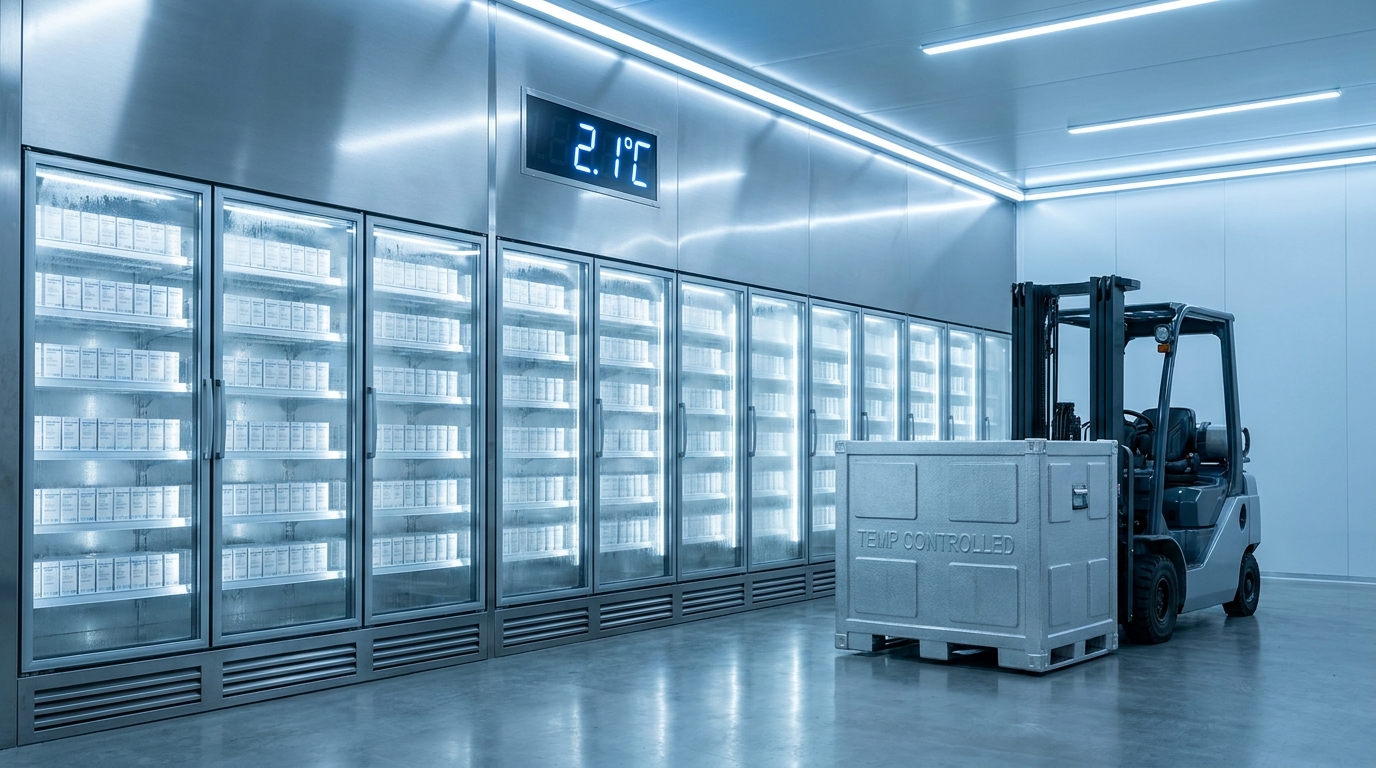
The pharmaceutical cold chain is the temperature-controlled network of storage and transport that keeps drugs, vaccines, and biologics within their approved temperature range from the manufacturer to the patient. It is not one temperature but several defined bands, and the whole system runs under Good Distribution Practice (GDP), a quality framework regulators including the U.S. FDA use to judge whether medicines were handled correctly. A break in that chain can quietly reduce a product's potency or safety without any visible sign, which is why the discipline is built around proof rather than assumption.
Key takeaways
- The pharmaceutical cold chain spans multiple bands: controlled room temperature (about 20 to 25 C), refrigerated (2 to 8 C), frozen (roughly -25 to -10 C), and ultra-cold (about -80 to -60 C or colder).
- Good Distribution Practice is the governing standard: qualified facilities and vehicles, validated processes, trained people, monitoring, and full documentation.
- A temperature excursion triggers quarantine and a documented assessment against stability data, not automatic disposal.
- Storage, packaging, and shipping lanes must be qualified and validated before use, and monitored with calibrated data loggers throughout.
- Coolant type, from phase change materials to dry ice, is matched to the product's band and the qualified shipper, never chosen by habit.
What is the pharmaceutical cold chain?
The pharmaceutical cold chain is the end-to-end system that holds a temperature-sensitive medicine inside its labeled range at every step: manufacturing, warehouse storage, transport between facilities, distribution, and the final handoff to a pharmacy, clinic, or patient. If any link lets the product drift outside its band for too long, the chain is considered broken and the affected stock must be assessed before it can move on.
What makes it demanding is that temperature damage is usually invisible. A vaccine that spent hours too warm can look identical to one that was handled perfectly. Because you cannot inspect quality back into a biologic, the cold chain is designed to prevent and detect deviations, and to prove after the fact that a shipment stayed in range. This is the same logic behind broader cold chain logistics, applied to products where the stakes are patient safety.
What is Good Distribution Practice (GDP)?
Good Distribution Practice is the quality-system standard for storing and transporting medicines so they reach the patient unaltered and traceable. It is the distribution counterpart to Good Manufacturing Practice, and it is what an auditor or regulator checks a distributor, warehouse, or carrier against.
In practice, GDP expects a few consistent things: facilities and vehicles that are qualified for the job, processes that are validated and written down, staff who are trained, temperature that is monitored and recorded, and a clear chain of custody so any unit can be traced. The exact legal requirements differ by country and by product type, so the safe move is to confirm specifics with the relevant authority rather than assume one country's rules apply everywhere. The FDA publishes guidance on drug distribution and supply-chain security that sets expectations in the United States.
What are the pharmaceutical temperature bands?
Pharmaceutical products are grouped into standardized temperature bands, and each product's approved label states which one it belongs to. The four you will meet most often are controlled room temperature, refrigerated, frozen, and ultra-cold. Ranges below reflect commonly used pharmacopeia and labeling conventions, but the product label always governs.
| Band | Typical range | Common examples | Usual coolant approach |
|---|---|---|---|
| Controlled room temperature (CRT) | About 20 to 25 C (68 to 77 F), with limited excursions allowed | Many tablets, some biologics stabilized for CRT | Insulated packaging, conditioned PCMs in hot or cold weather |
| Refrigerated | 2 to 8 C (36 to 46 F) | Many vaccines, insulin, some biologics | Conditioned gel packs or phase change materials |
| Frozen | Roughly -25 to -10 C (product-specific) | Certain vaccines and biologic products | Dry ice or frozen PCMs in qualified shippers |
| Ultra-cold / cryogenic | About -80 to -60 C, or -150 C and below cryogenic | Some mRNA vaccines, cell and gene therapies | Dry ice, ultra-low freezers, or liquid nitrogen |
Refrigerated (2 to 8 C) is the workhorse band
Most day-to-day pharmaceutical cold chain volume sits at 2 to 8 C. It is tight enough that a warm dock or a delayed truck can push product to the edge, but common enough that qualified equipment and packaging for it are widely available. For a deeper look at how these bands relate to food and industrial storage, see the sibling guide on cold storage temperature ranges.
Ultra-cold changed the equipment picture
The rise of mRNA vaccines and cell and gene therapies pushed more volume into the -80 to -60 C range and below. That band needs ultra-low freezers, dry ice replenishment, or liquid nitrogen, plus tighter handling windows, so it is worth confirming a provider genuinely operates at that band rather than assuming standard reefer capability covers it.
What does qualification and validation mean in the cold chain?
Qualification proves a specific piece of equipment or facility does what it should; validation proves a whole process reliably does what it should. Both are documented before routine use, and both are the backbone of a defensible GDP program.
Qualifying storage
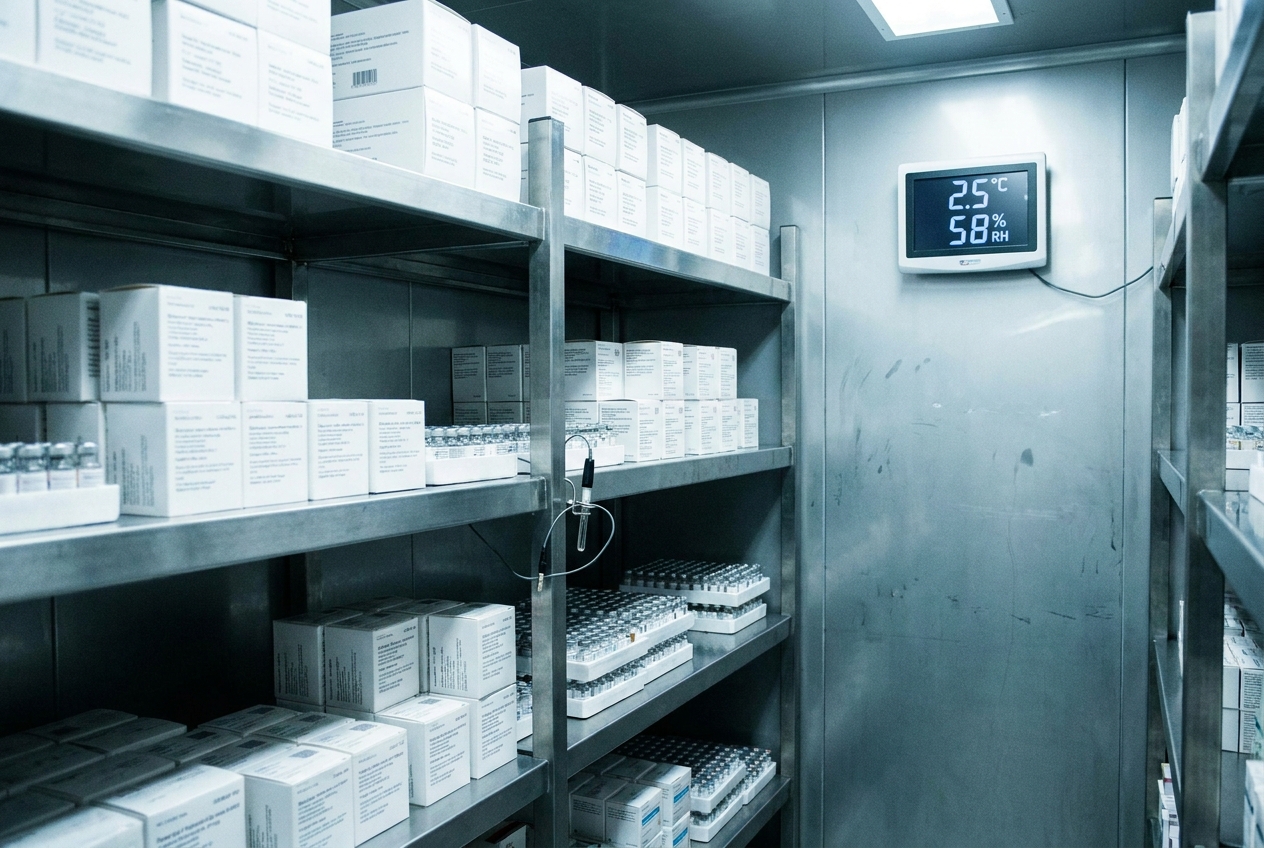
Qualifying a cold room, freezer, or refrigerator usually means temperature mapping: placing sensors throughout the space to confirm every shelf, corner, and door zone stays in range, including during door openings and a simulated power loss. The point is to find the warm and cold spots before product goes there, not after.
Validating transport and shipping lanes
Transport is validated as a lane, meaning a defined origin, route, mode, and packaging configuration tested against the seasonal extremes it will face. A packed shipper is often qualified to hold its band for a stated duration, for example a target of many hours to a few days, so the team knows the realistic window before the load is at risk. When you compare providers in the pharma cold chain directory, ask what lane validation and shipper qualification data they can show.
What is a temperature excursion, and what happens next?
A temperature excursion is any recorded event where product goes outside its labeled range for a defined period. It does not automatically mean the product is ruined, and treating every blip as a total loss is as wrong as ignoring it. The correct response is structured.
The standard sequence is to quarantine the affected stock so it cannot be shipped or used, log the excursion with its duration and magnitude, and have a qualified person assess it against the product's stability data before deciding to release or reject. Stability data, generated by the manufacturer, defines how much time out of range a product can tolerate. The sibling guide on what a temperature excursion is walks through the assessment logic in detail.
How is pharmaceutical cold-chain packaging designed?
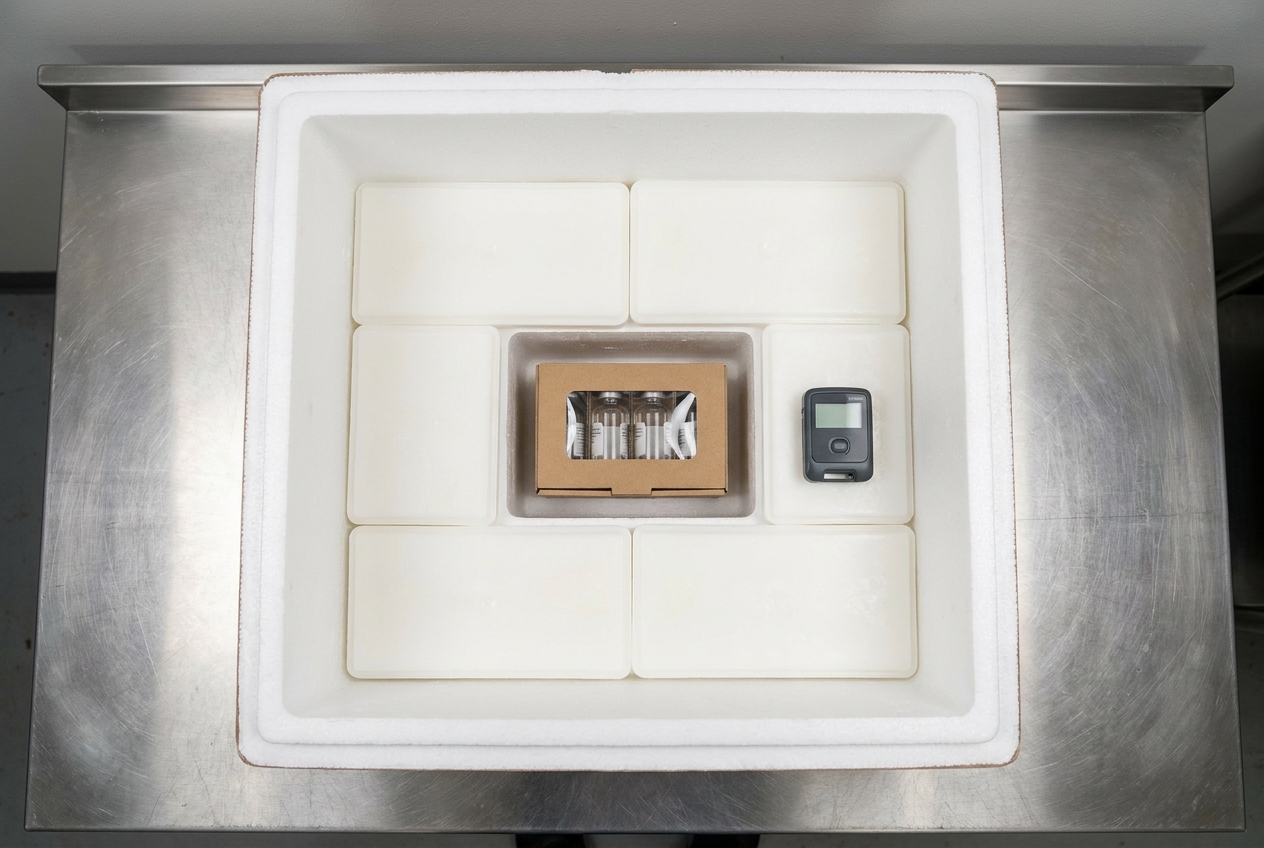
Cold-chain packaging is engineered as a qualified system, not a cooler with ice thrown in. The three building blocks are the insulated shipper, the coolant, and the payload space that holds the product, all validated together to keep the target band for a known duration.
Validated shippers
A validated shipper is an insulated container tested to hold a specific band for a stated time under defined conditions. Passive shippers rely on insulation and coolant alone; active or powered units use a compressor or other system. The qualification tells you how many hours or days you can trust it, which sets the deadline the whole lane must beat.
PCMs and dry ice
Phase change materials (PCMs) are engineered substances that hold a set temperature as they melt or freeze, and they are conditioned to the right point before packing. For 2 to 8 C loads, PCMs and gel packs are conditioned so they neither freeze the product nor let it warm. Dry ice, which sublimes near -78.5 C, is used for frozen and some ultra-cold shipments. Because dry ice releases carbon dioxide gas, it carries handling and transport-safety rules of its own, so match it to the product band and the qualified shipper rather than defaulting to it. For a broader treatment, see the sibling cold chain packaging guide.
How do you monitor and log temperature?
Monitoring means continuous, calibrated measurement of temperature across storage and transport, recorded at set intervals so the full history of a shipment can be reconstructed. Data loggers travel with the product, fixed sensors watch cold rooms and freezers, and alarms flag out-of-range events in real time where the system supports it.
Two details separate a real program from a checkbox. First, sensors and loggers must be calibrated on a schedule, because an uncalibrated logger that reads two degrees low is worse than none. Second, records must be retained and reviewable so a qualified person can look back and confirm a shipment stayed in range. The related guide on temperature monitoring for cold storage covers logger types and placement.
A worked example: a 2 to 8 C vaccine shipment
Say a distributor ships a refrigerated vaccine, labeled 2 to 8 C, in a passive shipper validated to hold that band for up to 72 hours with PCMs conditioned to 5 C. A calibrated data logger rides inside next to the payload. The lane is a two-day ground route validated for summer heat.
Mid-route, the truck sits at a warm cross-dock and the logger later shows the payload touched 9 C for 40 minutes. On arrival, receiving does not put the stock away. It quarantines the units, pulls the logger data, and a qualified person compares the 40-minute, 1-degree excursion against the manufacturer's stability data, which in this scenario permits limited short excursions. The stock is released with the event documented. Had the excursion been longer or the stability data tighter, the same process could have led to rejection. The discipline is identical either way: quarantine, review against data, document, decide.
How do you qualify a cold-chain 3PL or carrier?
Qualifying a partner means confirming, with evidence, that they run a real GDP-aligned operation for your specific band. The provider directory of pharmaceutical cold chain companies is a starting point, but the diligence is what protects you.
- Ask which temperature bands they are actually qualified for, and request the mapping and qualification records for the storage that will hold your product.
- Ask for lane validation and shipper qualification data for routes like yours, including seasonal extremes.
- Confirm how they monitor, whether loggers are calibrated, and how records are retained and shared.
- Confirm their excursion process: quarantine, assessment, and who is qualified to release or reject.
- Confirm training, standard operating procedures, and how they handle after-hours alarms and power loss.
If a provider cannot produce qualification, validation, and monitoring records on request, treat that as a red flag regardless of how strong the sales pitch is. You can compare and shortlist candidates through the broader logistics company directory.
What are the common failure points and red flags?
Most cold-chain failures happen at predictable seams rather than in the middle of a well-run route. Knowing them tells you where to look first.
- Dock and dwell time: product sitting on a warm loading dock or at an unrefrigerated cross-dock while waiting to move.
- Unconditioned coolant: PCMs or gel packs packed at the wrong starting temperature, which can freeze a 2 to 8 C product or fail to protect it.
- Uncalibrated or missing loggers, which leave you unable to prove compliance even if the product was fine.
- Using an unqualified shipper or exceeding its validated hold time on a delayed route.
- No written excursion procedure, so staff either ship suspect product or scrap good product out of caution.
What documentation should you keep?
Under GDP, the record is the proof. Keep qualification and mapping records for storage, validation reports for shippers and lanes, calibration certificates for sensors and loggers, the temperature history for each shipment, and the excursion assessments and release or reject decisions. Retention periods vary by jurisdiction and product, so confirm the requirement with the applicable authority. The FDA's work under the Food Safety Modernization Act shows how heavily temperature-controlled supply chains lean on documented, traceable handling, a principle that carries directly into pharmaceutical distribution.
Done well, the pharmaceutical cold chain is undramatic: qualified equipment, validated packaging and lanes, calibrated monitoring, and a clear excursion process, all documented so any shipment's history can be reconstructed. If you are building or auditing one, start by confirming the exact band each product needs, then work backward through storage, packaging, transport, and monitoring, and make sure every partner can prove, not just promise, that they hold it.
Frequently asked questions
What temperature is the pharmaceutical cold chain?
There is no single temperature. The pharmaceutical cold chain covers several bands, most commonly controlled room temperature (about 20 to 25 C), refrigerated (2 to 8 C), frozen (roughly -25 to -10 C), and ultra-cold (about -80 to -60 C or colder). Each product's approved label states the range it must stay within.
What is GDP in pharmaceutical distribution?
GDP stands for Good Distribution Practice, the set of quality-system expectations for storing and transporting medicines so they reach patients unaltered. It covers qualified facilities and vehicles, validated processes, trained staff, temperature monitoring, documented procedures, and traceability. Requirements vary by country, so confirm the exact rules with the relevant authority such as the FDA.
What is a temperature excursion?
A temperature excursion is any recorded event where a product goes outside its labeled storage range for a defined period. It does not automatically mean the product is ruined. The standard response is to quarantine the affected stock, log the event, and have a qualified person assess it against stability data before releasing or rejecting it.
Is dry ice or gel pack better for shipping medicine?
It depends on the target band. Phase change materials and gel packs conditioned to the right temperature are used for refrigerated 2 to 8 C shipments, while dry ice, which sublimes near -78.5 C, is used for frozen and some ultra-cold loads. The coolant must be matched to the product range and the qualified shipper it is used in, not chosen by habit.
What does qualification and validation mean for cold storage?
Qualification proves a piece of equipment or a facility performs as intended, for example that a cold room holds 2 to 8 C in every corner and during a power loss. Validation proves a whole process, such as a packed shipper or a shipping lane, reliably keeps product in range across expected conditions. Both are documented before routine use and re-checked over time.
How is the pharmaceutical cold chain monitored?
With calibrated data loggers and sensors that record temperature at set intervals across storage and transport, backed by alarms for out-of-range events. Records are retained so a qualified reviewer can reconstruct the full temperature history of a shipment and decide whether it stayed compliant.
Ready to compare providers?
Search the directory by service and location, save options to your shortlist, and send a clear RFQ.
Related guides
What Is a Reefer Container?
A reefer container is a refrigerated shipping container with its own built-in cooling unit that holds a set temperature across ship, rail, and road.
Cold Storage Costs Explained
What drives cold storage cost, how it differs from ambient warehousing, and how to compare quotes line by line before you sign.
What Is Blast Freezing and When Is It Used?
Blast freezing rapidly freezes product with high-velocity, very cold air so ice crystals stay small and quality holds. Here is how it works and when to use it.