
Cold Storage Costs Explained
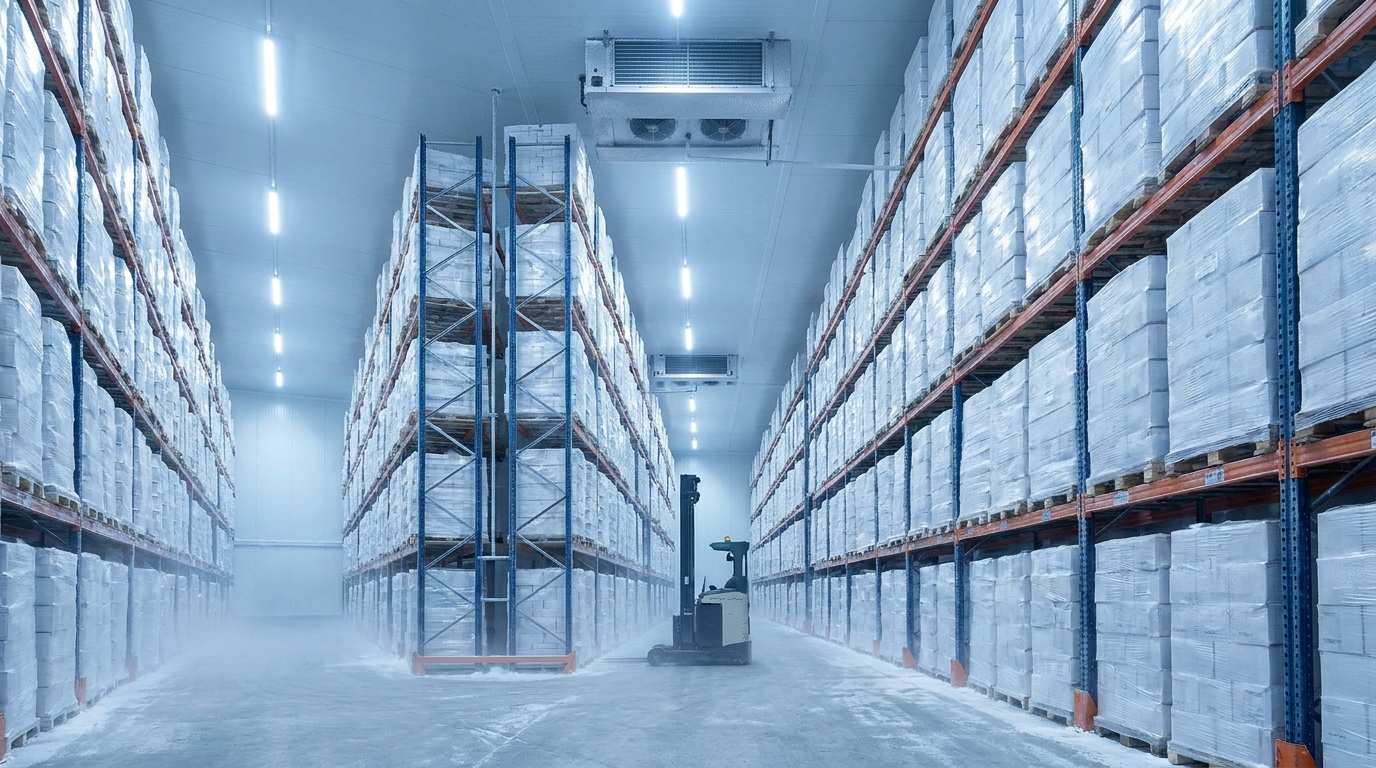
Cold storage cost is driven by six main factors: the temperature zone you need, how storage is measured and billed, how long inventory sits, how often it is handled in and out, whether product must be blast frozen on site, and the energy required to hold temperature around the clock. Because refrigeration runs continuously and food-safety controls add overhead, refrigerated and frozen space costs meaningfully more than ambient warehousing. Rather than chase a single per-pallet number, the useful skill is reading a quote line by line so you can compare providers on the same basis.
Key takeaways
- Cold storage is priced on a recurring storage fee plus separate handling fees, so a low storage rate can still lose to a competitor once handling and accessorials are added.
- The temperature zone matters most: frozen space costs more than refrigerated, which costs more than chilled, because a lower hold temperature is harder and more energy-intensive to maintain.
- Dwell time turns storage into your biggest lever. Slow-moving inventory accrues more months of storage fees, while fast turnover shifts cost toward handling.
- Blast freezing, kitting, temperature monitoring, and special handling are usually billed as accessorials on top of storage, not included in it.
- To compare quotes fairly, normalize every one to the same unit of measure, temperature zone, dwell time, and monthly handling volume before you look at price.
What drives cold storage pricing?
Cold storage pricing is built from a recurring storage charge and a set of activity-based charges, and the total depends on how your inventory behaves over a month. The recurring piece pays for the refrigerated space your product occupies. The activity-based pieces pay for moving product in and out, freezing it, and any handling beyond basic putaway and pick. Understanding which bucket a fee falls into is the first step to comparing providers, because two quotes with the same headline storage rate can differ widely once activity is priced in.
The main cost drivers are the temperature zone, the storage unit basis, dwell time, inbound and outbound handling, blast freezing, energy, and special handling. Each one moves the total in a predictable direction, and most providers will break them out if you ask.
How much does each cost driver add?
Every driver pushes cost in a consistent direction even though the exact rate varies by market, provider, and volume. The table below summarizes what each driver is and why it moves the price, using directional effects rather than fixed numbers, since real rates depend on your region and commitment.
| Cost driver | What it is | Effect on cost |
|---|---|---|
| Temperature zone | Chilled, refrigerated, or frozen hold temperature | Lower temperature raises cost; frozen is the most expensive zone |
| Storage unit basis | Billed per pallet, per square foot, or per cubic foot | Basis changes how efficiently you can pack space and control cost |
| Dwell time | How long inventory sits before it ships | Longer dwell means more recurring storage months per unit |
| Handling in and out | Receiving, putaway, picking, and loadout | More frequent handling raises activity fees regardless of storage |
| Blast freezing | Rapidly freezing product on site | Adds a distinct charge, often per pallet or per pound |
| Energy | Continuous refrigeration and backup power | Baked into rates; efficient facilities can pass on lower cost |
| Special handling | Kitting, labeling, monitoring, lot control | Billed as accessorials on top of base storage and handling |
How does cold storage differ from ambient warehousing?
Cold storage costs more than dry warehousing because it runs refrigeration continuously and layers on controls that ambient space does not need. An unheated dry warehouse mostly pays for the building, labor, and racking. A refrigerated facility adds compressors, insulated construction, backup power, temperature monitoring, and tighter food-safety procedures, and all of that shows up in the rate. The gap widens as the required temperature drops, so a frozen room costs more to run than a cooler holding produce.
The practical consequence is that space you would treat as cheap in a dry network becomes a real constraint in cold. Idle refrigerated pallets are expensive, so cold storage rewards tight inventory discipline. If your product does not need temperature control for its full life, splitting temperature-sensitive stock into cold and the rest into ambient can lower total cost. For how refrigerated inventory moves through a temperature-controlled network, see our guide to cold chain logistics.
How is cold storage measured and billed?
Cold storage is usually billed on one of three bases: per pallet, per square foot, or per cubic foot, and the basis you are quoted changes how you should think about cost. Per-pallet pricing is simple and common, but it can penalize you if your pallets are short or lightly loaded, since you pay per position regardless of how full it is. Square-foot pricing ties cost to floor area and rewards dense, tall stacking. Cubic-foot pricing charges for the actual volume your product occupies and can favor irregular or high-cube loads.
Whatever the basis, storage is recurring, typically charged monthly or by a shorter cycle, and handling is separate. Ask each provider to state the unit, the billing cycle, and whether partial periods are prorated or rounded up. To model the recurring side against square footage and rate assumptions, our warehouse cost calculator gives you a working baseline.
Why does temperature zone change the price so much?
The temperature zone is the single biggest driver because holding a lower temperature takes more energy and more robust equipment. Chilled space near the high end of refrigeration is the least costly to maintain, refrigerated space for most perishables sits in the middle, and deep-frozen space is the most expensive because compressors work harder and any temperature excursion is more damaging. If your product tolerates a slightly warmer zone, you may pay less by choosing the right zone rather than defaulting to the coldest one available.
Matching product to zone also protects quality, which is a cost in its own right through spoilage and rejected loads. If you are unsure which zone your product needs, our overview of frozen, refrigerated, and chilled storage lays out the differences and where common products fall.

What does blast freezing and special handling cost?
Blast freezing and special handling are accessorials, billed on top of storage rather than inside it. Blast freezing rapidly drives product down to a frozen temperature and is typically charged per pallet or per pound, so if your goods arrive fresh or warm and must be frozen on site, treat it as its own budget line. Special handling covers work such as kitting, case picking, labeling, lot and date control, and temperature monitoring reports, each of which can be a separate fee.
These charges are easy to overlook because they do not appear in a simple storage rate, yet they can dominate the bill for a fast-moving or highly processed product. When you request quotes, list every activity your product needs so providers price the whole scope. Our guide on how to choose a cold storage provider covers the questions that surface these fees.
How do energy costs shape cold storage rates?
Energy is embedded in every cold storage rate because refrigeration runs continuously, and a more efficient facility can pass on a lower effective cost. Insulation quality, door discipline, LED lighting, high-efficiency compressors, and thermal management all affect how much power a facility burns to hold temperature. You will not see a separate energy line on most quotes, but it is a real reason two facilities in the same market can quote different rates.
When you tour or vet a provider, efficiency is a fair thing to ask about, both for cost and for reliability during heat waves or grid stress. The federal Energy Star program publishes guidance on warehouse and refrigerated-facility energy efficiency that explains what an efficient operation looks like. For temperature-sensitive food, providers also operate under food-safety expectations set by the FDA FSMA rules, which shape monitoring and handling practices that feed into cost.
How should I compare cold storage quotes?
Compare quotes by normalizing them to the same assumptions before you look at price, because the headline storage rate rarely tells the whole story. Put every quote on the same unit of measure, the same temperature zone, the same expected dwell time, and the same monthly inbound and outbound handling volume. Then add the accessorials each provider charges for the activities your product actually needs. Only after that do the totals become comparable.
Consider a brand storing 100 frozen pallets that turn over once a month. A provider with a low per-pallet storage rate but high receiving and shipping fees may cost more than one with a slightly higher storage rate and lean handling, because handling happens 100 times a month while storage is billed once. Reverse it for slow-moving safety stock that sits for a quarter, and the low storage rate wins. The right choice depends on your turnover, not any single number. Watch for minimum monthly charges, minimum pallet counts, and long-term commitments, which change the effective per-unit cost. When you are ready to see who serves your lanes, browse cold storage warehousing providers and request quotes on a like-for-like scope.
Frequently asked questions
Why is cold storage more expensive than dry warehousing?
Cold storage runs refrigeration around the clock, carries higher energy and equipment costs, and often requires temperature monitoring, backup power, and food-safety controls that ambient warehouses do not. Frozen space costs more than chilled because it must hold a lower, harder-to-maintain temperature.
How is cold storage usually priced?
Most providers charge a recurring storage fee based on the pallet, the square foot, or the cubic foot, plus separate handling fees for receiving and shipping. Some blast freezing, kitting, and special handling are billed on top as accessorials. Always confirm the unit of measure before comparing quotes.
What is a storage dwell time and why does it affect cost?
Dwell time is how long inventory sits before it ships. Storage is a recurring charge, so slow-moving product accrues more months of fees. Fast turnover lowers storage cost per unit but raises handling cost, so the mix matters more than any single rate.
Does blast freezing cost extra?
Yes. Blast freezing rapidly drops product to a frozen temperature and is typically billed separately from storage, often per pallet or per pound. If your product arrives warm or fresh and must be frozen on site, budget for this as a distinct line item.
How do I compare cold storage quotes fairly?
Normalize every quote to the same unit and the same assumptions: temperature zone, storage basis, expected dwell time, monthly inbound and outbound handling volume, and any accessorials. A low storage rate can hide high handling or minimums that make the total more expensive.
Are there minimums in cold storage contracts?
Often yes. Providers may set minimum monthly storage charges, minimum pallet counts, or minimum handling volumes to reserve refrigerated space. Ask about minimums and any long-term commitment before signing, because they change the effective per-unit cost.
Ready to compare providers?
Search the directory by service and location, save options to your shortlist, and send a clear RFQ.
Related guides
What Is Blast Freezing and When Is It Used?
Blast freezing rapidly freezes product with high-velocity, very cold air so ice crystals stay small and quality holds. Here is how it works and when to use it.
What Is Cold Chain Logistics?
Cold chain logistics is the end-to-end system that keeps temperature-sensitive freight within a set range from origin to destination. Here is how the links, monitoring, and compliance fit together.
Temperature Monitoring in Cold Storage
Temperature Monitoring in Cold Storage: Questions Buyers Should Ask Temperature monitoring in cold storage is one of the most important details companies should review before choosing a warehouse. A facility may advertise frozen, refrigerated, chilled, or temperature-controlled storage, but buyers need to understand how those temperatures are tracked, recorded, and managed. For food brands, importers, […]