
Cold Chain Packaging: Gel Packs, Dry Ice, and PCMs
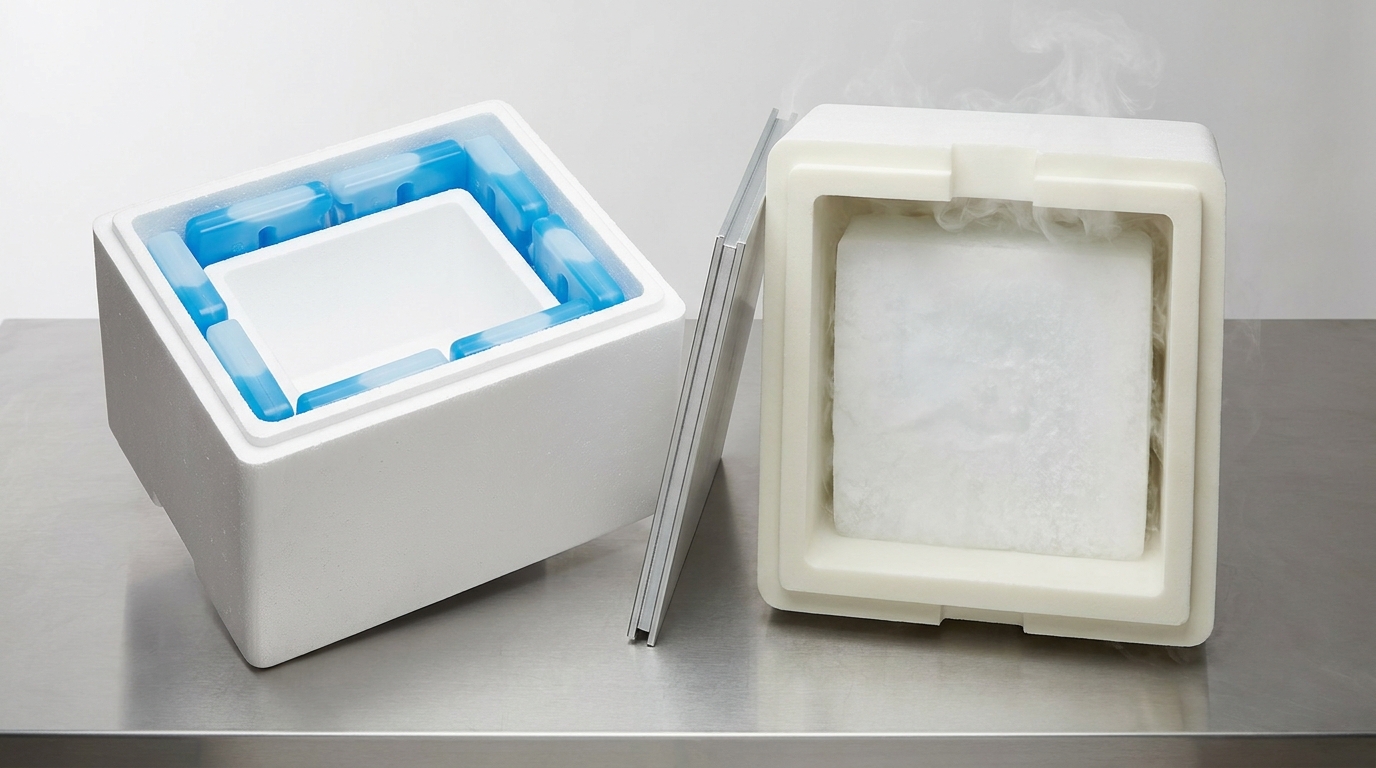
Cold chain packaging is the insulated shipper, refrigerant, and dunnage that hold a product inside a target temperature band from pickup to delivery. It has three working parts: a refrigerant that removes heat (gel packs, dry ice, or phase-change materials), insulation that slows heat from getting in (EPS foam, polyurethane, or vacuum-insulated panels), and a payload space sized so the product never sits directly against the coolant. The right combination depends on the temperature range you need to hold and how long the box will be in transit.
Key takeaways
- Cold chain packaging works only as a system: refrigerant, insulation, and payload space are qualified together for one temperature band and transit duration.
- Gel packs suit refrigerated and chilled loads, dry ice suits frozen and deep-frozen loads, and phase-change materials hold a narrow set-point band most precisely.
- Dry ice is a regulated hazardous material (UN1845) and triggers dangerous-goods rules for air shipping.
- A package is not ready until it is tested against a stated ambient profile and hold time, not just filled with coolant.
What are the parts of a cold chain shipping package?
A cold chain package is a layered system, not a single product. Three elements do the work, and each one has to match the others.
- Refrigerant. The gel pack, dry ice, or phase-change material that absorbs heat and holds the interior cold. Its temperature and quantity set how cold the box gets and how long it stays there.
- Insulation. The walls of the shipper, made of EPS foam, polyurethane, or vacuum-insulated panels. Insulation slows the rate that outside heat leaks in, which stretches hold time.
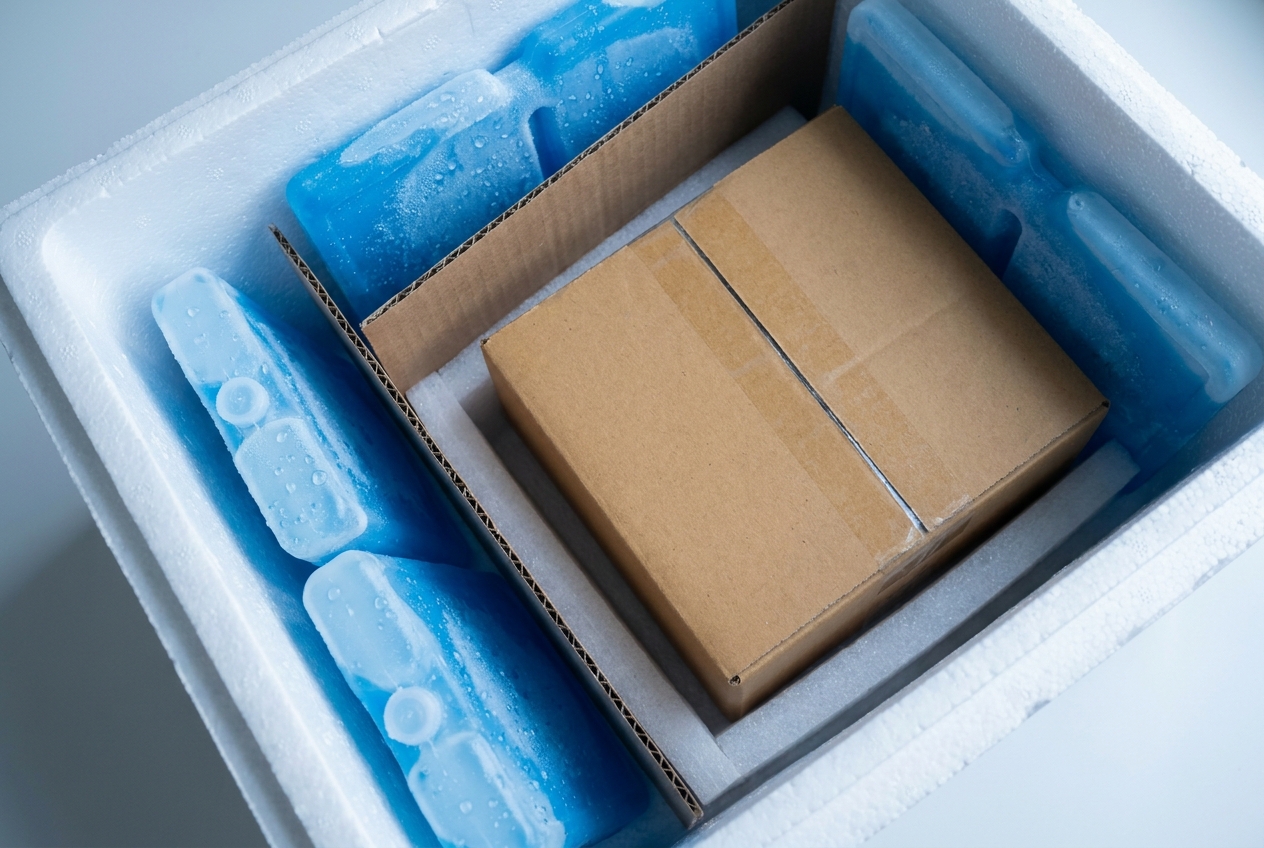
- Payload space and dunnage. The sized cavity where the product sits, plus barriers that keep it from touching the coolant directly. Frozen coolant against a refrigerated-only product can freeze and ruin it.
Get the mix wrong and the shipment fails even with plenty of coolant. This is the same discipline covered in what cold chain logistics means end to end, applied at the box level.
How do gel packs, dry ice, and PCMs compare?
Each refrigerant holds a different temperature range and carries different trade-offs. Gel packs are water-based and reusable, dry ice is solid carbon dioxide that sublimates directly to gas, and phase-change materials (PCMs) are engineered to melt and freeze at a fixed set point. The table below summarizes where each one fits.
| Refrigerant | Typical temperature use | Best for | Trade-offs |
|---|---|---|---|
| Gel packs | Refrigerated (about 2 to 8C) when refrigerated-conditioned; below freezing when frozen-conditioned | Chilled and refrigerated food, many biologics | Reusable and non-hazardous, but heavier and shorter hold time; can freeze a refrigerated-only product if used frozen |
| Dry ice | Frozen and deep-frozen; sublimates near -78.5C (-109F) | Frozen food, frozen pharma, some specimens | Very cold and leaves no liquid residue, but is a regulated hazardous material and can over-freeze delicate products |
| Phase-change materials (PCMs) | Holds a chosen set point (for example 5C, -21C) | Tight-tolerance pharma and specialty loads | Most precise band, but costs more and must be pre-conditioned correctly before packing |
For food shipments, matching the refrigerant to the product's required band is part of staying compliant with FDA food-safety (FSMA) requirements. If you are unsure which band your product needs, start with a review of standard cold storage temperature ranges.
When should you use gel packs versus dry ice versus PCMs?
Pick the refrigerant from the product's temperature requirement first, then adjust for cost and hold time. Gel packs are the default for anything that must stay refrigerated but not freeze. Dry ice is the default when the product must stay frozen for the whole trip. PCMs earn their higher cost when the band is narrow and a failure is expensive, which is common in pharmaceutical cold chain shipping.
A quick rule of thumb: if freezing the product is unacceptable, do not ship it with dry ice pressed against it. If the product is already frozen, gel packs alone often will not keep it there for a multi-day lane.
What insulation options are used in cold chain packaging?
Insulation sets how long the refrigerant lasts. The three common wall materials trade cost against performance.
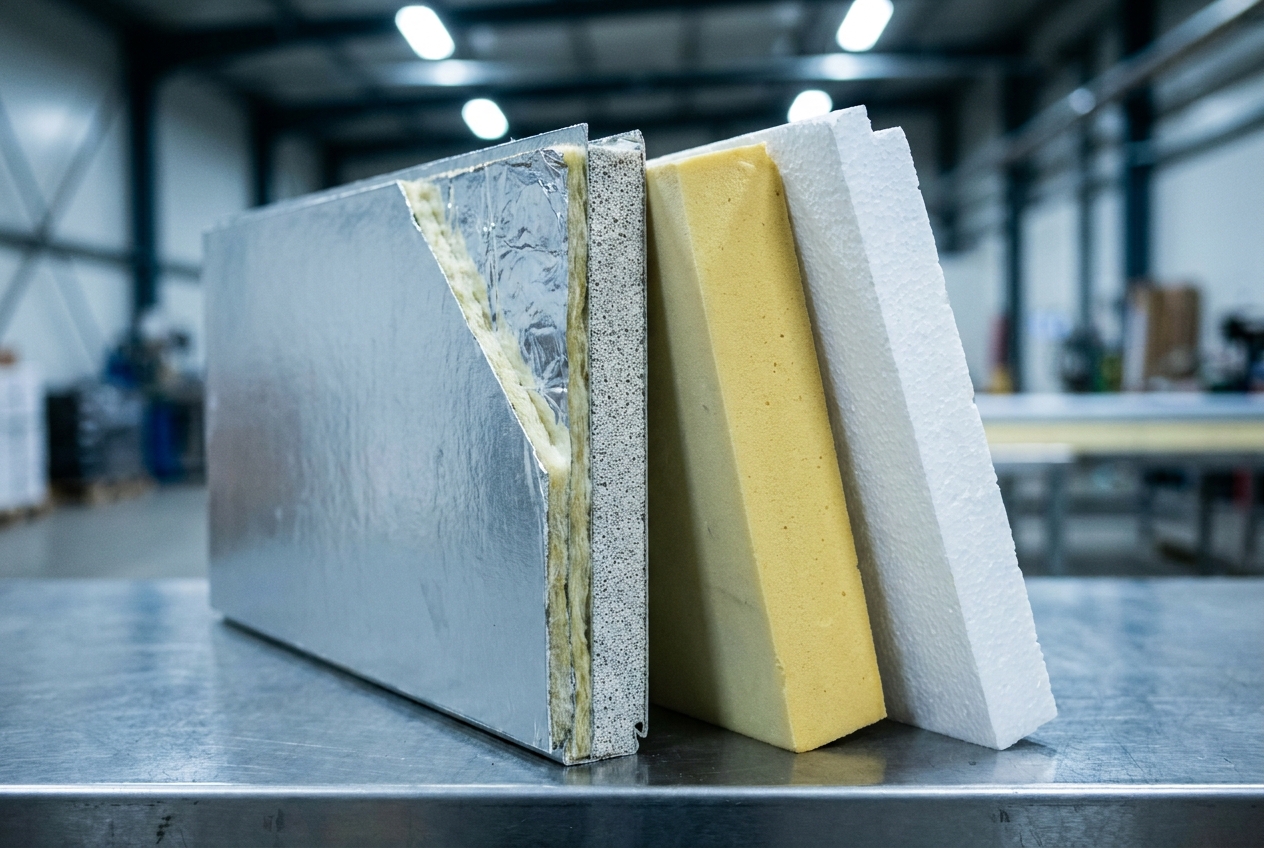
- EPS foam (expanded polystyrene). The low-cost, widely available default. Good enough for short refrigerated lanes of roughly a day or two, but bulky for the insulation it delivers.
- Polyurethane (PU) foam. A higher R-value per inch than EPS, so it holds temperature longer in the same wall thickness. It costs more and suits longer transit windows.
- Vacuum-insulated panels (VIPs). The highest insulation in the thinnest wall, built for multi-day and pharmaceutical shipments. They are expensive and can be damaged if punctured, so they are usually paired with PCMs and a protective outer shell.
Longer transit and tighter temperature tolerance push you up this list from EPS toward VIPs.
Why is dry ice a regulated hazardous material?
Dry ice is classified as a hazardous material, assigned UN1845, because it sublimates into carbon dioxide gas rather than melting into liquid. In a sealed or poorly ventilated space that gas can displace oxygen and build pressure, which is a safety risk for handlers and, especially, for aircraft. Air shipments must follow dangerous-goods rules covering the quantity per package, outer marking, and documentation, and ground transport falls under Department of Transportation hazardous materials regulations.
The practical effect: a dry-ice parcel is not just a colder box. It needs correct labeling and paperwork, and carriers cap how much dry ice a single package may contain. If your lane mixes dry ice with other regulated goods, treat it under the same discipline as any other hazmat freight shipment.
How is cold chain packaging qualified for a temperature band and transit time?
Qualification means proving a specific shipper configuration holds its temperature band for a stated duration under a defined ambient profile, before you trust it with real product. You cannot assume a box works because it feels cold; you test it. Qualification fixes four things:
- Temperature band. The exact range the product must stay within, for example 2 to 8C or below -15C.
- Ambient profile. The outside conditions the box must survive, usually a hot summer profile and a cold winter profile, since heat and cold both break a shipper.
- Transit duration. The hold time the box is rated for, such as 48 or 96 hours, with a margin for delays.
- Payload and coolant. The product volume, refrigerant type and quantity, and the pre-conditioning temperature of that refrigerant.
Change any one of those, such as shrinking the payload or swapping gel packs for PCMs, and the box has to be re-qualified. This is why a validated shipper is rated for a range, not a single guaranteed number.
What does a qualified cold chain shipment look like in practice?
Consider a shipper moving a refrigerated biologic that must stay between 2 and 8C for a two-day transit in summer heat. A qualified setup might pair a polyurethane shipper with refrigerated-conditioned gel packs, arranged around the payload with a barrier layer so the product never contacts a pack directly. The gel packs are pre-conditioned to a specific temperature, the payload cavity is sized to the tested volume, and the whole configuration was already run through a hot-ambient thermal test proving it holds 2 to 8C past the 48-hour mark.
If that same product had to stay frozen instead, the design would shift to dry ice inside a heavier-insulated shipper, plus the hazmat marking and documentation dry ice requires. Same product family, different band, different qualified package.
How do you choose the right cold chain packaging?
Start from the product's required temperature band and the longest realistic transit time on the lane, then work backward to a refrigerant and insulation pairing and qualify it. Do not reverse-engineer from whatever box is on the shelf. If in-house testing is not practical, a temperature-controlled provider can qualify and run the packaging for you. You can compare vetted operators in the cold storage and warehousing directory to find partners with validated shipping systems for your temperature range.
Frequently asked questions
What is cold chain packaging?
Cold chain packaging is the insulated shipper plus refrigerant that holds a product inside a target temperature band from pickup to delivery. It combines a refrigerant (gel packs, dry ice, or phase-change materials), insulation (EPS foam, polyurethane, or vacuum-insulated panels), and a payload space sized so the product does not touch the coolant directly.
What is the difference between gel packs, dry ice, and PCMs?
Gel packs are water-based refrigerants that hold refrigerated or frozen loads and are reusable and non-hazardous. Dry ice is solid carbon dioxide that sublimates near -78.5C (-109F) and is used for frozen and deep-frozen goods, but it is a regulated hazardous material. Phase-change materials melt and freeze at a fixed set point, so they hold a narrow temperature band more precisely than either.
Is dry ice considered hazardous material for shipping?
Yes. Dry ice is classified as a hazardous material (UN1845) because it sublimates into carbon dioxide gas, which can displace oxygen and build pressure in a sealed space. Air shipments must follow dangerous-goods rules for quantity, marking, and documentation, and ground transport is covered by Department of Transportation hazardous materials regulations.
How do you qualify cold chain packaging for a shipment?
Qualification means testing a specific shipper configuration against a defined temperature band, ambient profile (summer or winter), and transit duration. You fix the payload size, coolant type and quantity, and pre-conditioning, then run thermal tests to confirm the box stays in range for the stated hold time before using it in production.
How long can cold chain packaging hold temperature?
Hold time depends on the insulation, the refrigerant, and the ambient temperature, and it is stated as a qualified duration rather than a fixed number. Simple EPS-and-gel systems commonly target roughly 24 to 48 hours, while polyurethane or vacuum-insulated-panel systems with PCMs are built for longer 72-hour-plus lanes. Always use the tested hold time for your configuration, not a general estimate.
Which insulation is best for cold chain packaging?
It depends on transit time and budget. EPS foam is cheap and common for short refrigerated lanes, polyurethane offers a higher R-value for longer transit, and vacuum-insulated panels give the highest insulation in the thinnest wall for multi-day or pharmaceutical shipments. Longer duration and tighter tolerance push you toward polyurethane or vacuum-insulated panels.
Ready to compare providers?
Search the directory by service and location, save options to your shortlist, and send a clear RFQ.
Related guides
Frozen Food Logistics: Storage and Transport
How frozen food moves from blast freezing and cold storage through reefer transport to last-mile delivery, plus how to choose a frozen 3PL.
What Is a Temperature Excursion?
A temperature excursion is any time a temperature-sensitive product drifts outside its approved range. Here is what causes them, how to detect and respond, and how to prevent them.
Pharmaceutical Cold Chain: A Compliance Guide
How the pharmaceutical cold chain keeps drugs within validated temperature bands, from 2-8C refrigerated to ultra-cold, under Good Distribution Practice.