
What Is Heavy Haul Trucking? Permits and Escorts
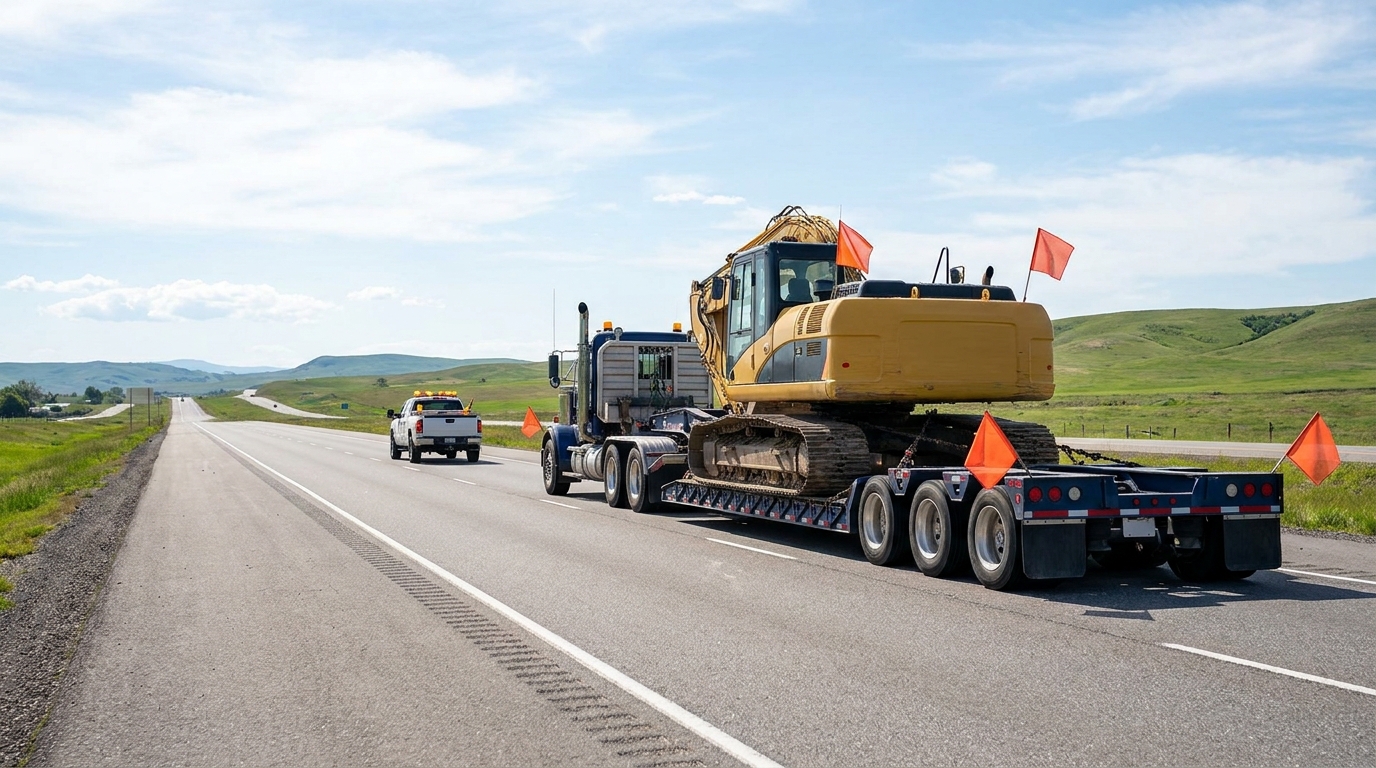
Heavy haul trucking is the specialized transport of freight that is too large or too heavy to move on a standard trailer within legal limits. When a load exceeds the width, height, length, or weight a truck can legally carry without a permit, it becomes a heavy haul move, which means specialized trailers, state-issued permits, and often pilot cars or police escorts. Typical heavy haul freight includes construction machinery, industrial equipment, transformers, wind turbine components, prefabricated structures, and oversized steel. Because each state sets its own limits and rules, the same load can be routine in one state and a permitted superload in the next.
Key takeaways
- Heavy haul covers any load that exceeds legal dimension or weight limits, so most heavy haul freight is both oversize and overweight.
- Permits are issued state by state, and a single interstate move needs a separate permit and route approval for every state it crosses.
- Escort requirements scale with the load: none for modest overages, one or more pilot cars for wide or long loads, and police escorts plus utility crews for the largest superloads.
- Superloads have no single national threshold; each state defines its own trigger, and they usually require engineered route surveys and bridge analysis.
- Timelines are driven by permits, escorts, and route surveys, so multi-state and superload moves are planned in weeks, not hours.
What makes a load heavy haul instead of a legal load?
A load becomes heavy haul the moment it exceeds a legal limit for width, height, length, or weight and needs a permit to move. Below those limits, freight travels on standard flatbeds or step decks with no special authority. Above them, the shipment falls into permitted oversize or overweight territory, and the largest of those are classified as superloads. The exact numbers vary by state, but the categories work the same way everywhere.
| Category | Typical trigger | Permit | Escorts | Planning lead time |
|---|---|---|---|---|
| Legal load | Within standard width, height, length, and weight limits | None | None | Same or next day |
| Oversize / overweight (permitted) | Exceeds one or more legal limits but under superload thresholds | State permit per state crossed | Sometimes one or more pilot cars | Days |
| Superload | Exceeds the state's routine permit thresholds for size or weight | Special permit plus engineered review | Pilot cars, often police, sometimes utility crews | Weeks |
Because the thresholds differ, planning a route is partly a matter of finding the states and roads where the load stays in the cheapest category for the longest distance. Understanding how trailer types are configured is the starting point for knowing whether a load can be brought back under a limit or whether it is oversize no matter what.
What is a superload?
A superload is a load large or heavy enough to exceed the routine permit thresholds a state uses for standard oversize moves. There is no single federal number that defines one. Each state sets its own trigger, often expressed as a combination of extreme width, height, length, or gross vehicle weight, above which the permit stops being routine and becomes an engineered project. That distinction matters because a superload permit usually requires a formal route survey, structural analysis of every bridge on the route, and review by the state's transportation department before travel is approved.
Practically, a superload is the difference between a permit that clears in a few days and one that takes weeks. It is common for wind turbine blades, large transformers, refinery vessels, and heavy mining equipment. The heavier or taller the load, the more the route depends on infrastructure that was never designed for it, which is why states scrutinize these moves so closely.
What trailers move heavy haul freight?
Heavy haul uses purpose-built trailers that lower the deck, spread weight across more axles, or extend length to keep a load legal. The right trailer depends on whether the constraint is height, weight, or length. Choosing it is the first engineering decision of any heavy haul move.
Lowboy and RGN trailers
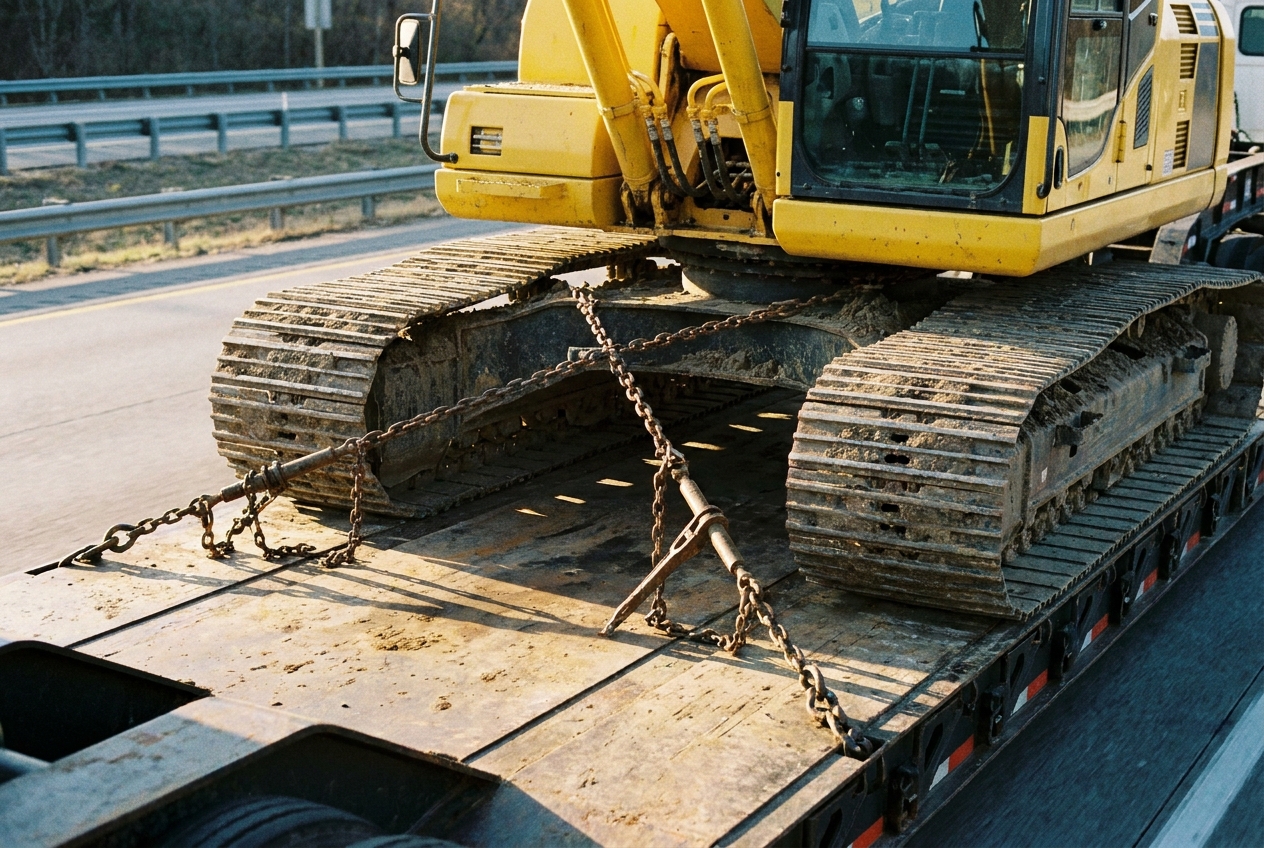
A lowboy is a trailer with a very low deck that sits close to the road so tall equipment stays under height limits. An RGN, or removable gooseneck, is a lowboy whose front section detaches to form a ramp so a machine can drive directly onto the deck. Lowboys and RGNs are the default for tracked and wheeled equipment such as excavators, dozers, and cranes, because the low deck buys back the height a tall machine would otherwise lose.
Multi-axle and extendable trailers
Multi-axle trailers add axles to distribute weight so no single axle or bridge point exceeds its limit. Very heavy loads sit on trailers with many axle lines, sometimes steerable, to stay within per-axle weight rules even when the gross weight is enormous. Extendable or stretch trailers lengthen to support long loads such as beams, poles, and blades so the freight is fully supported rather than overhanging.
Jeeps and boosters
A jeep is an extra axle set placed between the tractor and the trailer, and a booster is an extra axle set added behind the trailer. Both spread the load's weight across more axles and more distance, which lowers the weight carried at any one point and helps a heavy load satisfy bridge weight formulas. Adding jeeps and boosters is how carriers make an extremely heavy load legal on a route that would otherwise fail a bridge analysis.
How does heavy haul permitting work?
Heavy haul permits are issued state by state, so an interstate move needs a separate permit from each state's transportation department for the exact route, dimensions, and weight of the load. There is no single national permit. Each state runs its own portal, sets its own fees, defines its own thresholds, and specifies its own escort and travel rules. A permit is tied to a specific vehicle configuration and route, so a change in trailer, axle count, or path can require a new permit.
For routine oversize moves, many states issue permits quickly through online systems. As the load moves toward superload territory, the process adds engineering review, bridge analysis, and sometimes public agency sign-off, which extends the timeline. Federal size and weight limits on the Interstate System set the backdrop, and the Federal Motor Carrier Safety Administration governs the carrier safety side, but the permit itself always comes from the state. National freight and infrastructure data from the Bureau of Transportation Statistics helps explain why bridge capacity, not just road width, so often drives a route.
When do you need pilot cars and escorts?
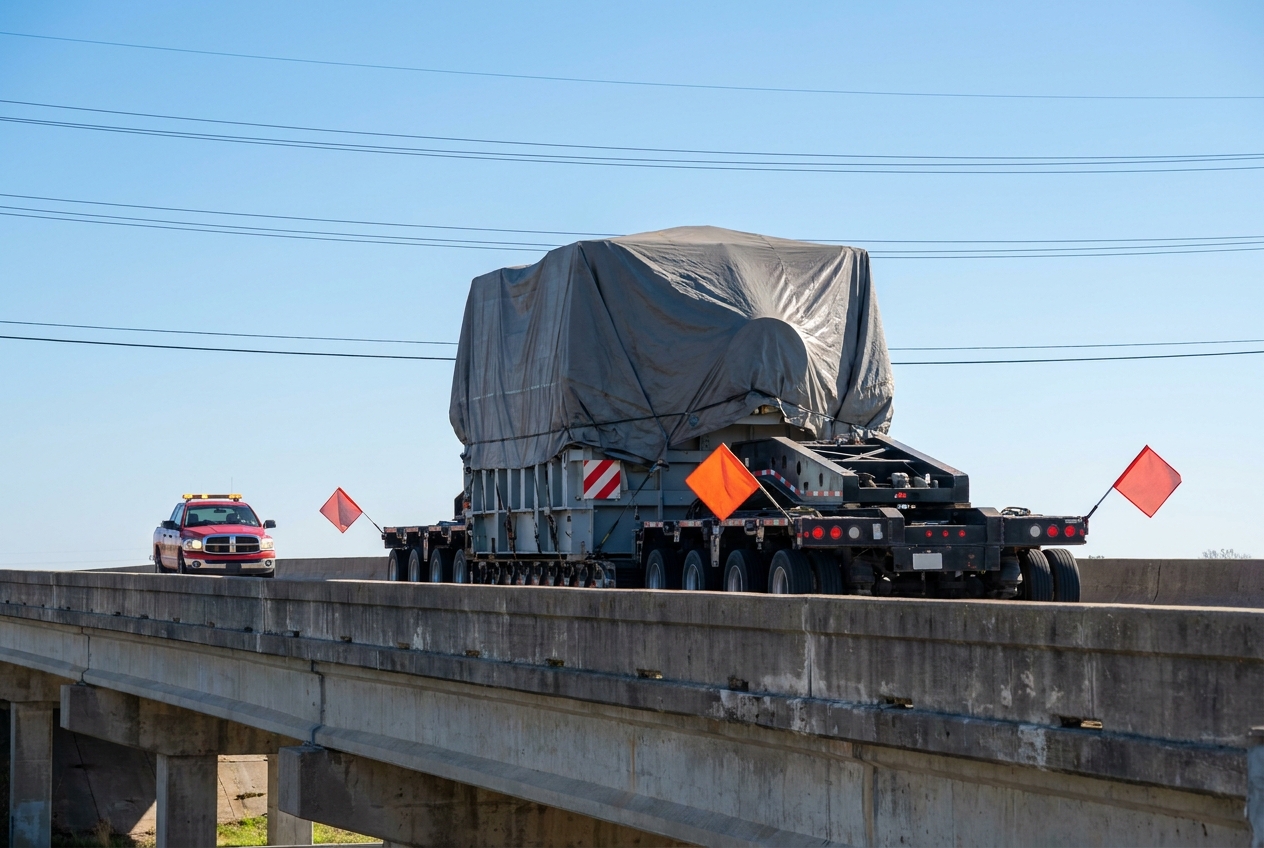
You need pilot cars, also called escorts, when a load's width, length, or height exceeds the point at which a state requires additional warning and traffic control. A modest overage may travel with no escort. As the load gets wider or longer, states require one pilot car, then two, positioned ahead of and behind the load to warn traffic, watch clearances, and manage turns. Very tall loads often require a height pole car that runs ahead to physically check overhead clearances before the load reaches them.
The permit for each state states exactly how many escorts are required and where they must be positioned. Escorts are usually certified and carry specific signage and lighting. Because escorts are booked separately in each state, a multi-state move means coordinating several escort providers along the route, which is one reason lead times grow with distance.
When are police escorts required?
Police escorts are required when a load is large enough that civilian pilot cars cannot safely manage the traffic and intersection control it needs. This typically applies to superloads and to moves through dense urban areas, complex interchanges, or routes where the load must temporarily cross the centerline or occupy multiple lanes. Law enforcement can stop traffic, hold intersections, and clear the path in ways a pilot car cannot.
Police escorts add cost and scheduling complexity because they depend on the availability of the relevant agency, and they often confine travel to specific low-traffic windows such as overnight or weekend hours. When a route survey flags a tight intersection or a lane closure, the state may mandate a police escort as a condition of the permit.
What is a route survey and why does it matter?
A route survey is a physical and engineering check that the chosen roads can carry the load: bridge capacity, overpass and tunnel clearances, turn radii, grades, low utility lines, and active construction. It matters because a heavy haul load cannot simply back up and try another road once it reaches an obstacle it cannot pass. On superloads, a survey is often required by the state before a permit is issued, and it can include a physical drive of the route to measure clearances that maps do not capture.
Route surveys frequently trigger the most time-consuming part of a move: coordination with utilities and municipalities. If overhead power, phone, or traffic-signal lines hang too low, the carrier must arrange for utility crews to lift or de-energize them as the load passes. Traffic signals and signs sometimes have to be temporarily removed. Each of these arrangements has its own lead time and approval, which is why route surveys are the backbone of a realistic schedule for oversized moves. Our guide to shipping oversized freight walks through how these surveys and clearances get sequenced.
How long does a heavy haul move take to plan?
Planning time is driven by permits, escorts, and route surveys, not by the driving distance. A routine oversize move within a single state can often be arranged in a few business days. A multi-state move, a superload, or any load needing a route survey and utility coordination commonly takes one to several weeks because each state permit, escort booking, bridge analysis, and utility lift has its own approval window and they do not fully overlap.
The actual driving can also be slower than a standard shipment. Many states restrict oversize travel to daylight hours, prohibit movement on weekends or holidays, and impose reduced speeds. A load that crosses several states may sit overnight waiting for the next state's legal travel window to open. Building these constraints into the schedule up front is what separates a move that arrives on time from one that stalls at a state line.
What drives the cost of a heavy haul move?
Heavy haul pricing is built from the base transport plus every added requirement the load triggers, so two moves over the same distance can cost very differently. The main cost drivers are the number and type of permits, the number of pilot cars or police escorts, whether a route survey and bridge analysis are needed, utility line lifts, specialized trailer type and axle count, and any detours the route forces. Fuel, deadhead miles to position the trailer, and travel-window restrictions that stretch the trip over more days add to it.
Because every load and route is different, reputable carriers quote heavy haul as a project rather than a flat per-mile rate. Ask for a line-item breakdown so you can see how much is permits, escorts, and surveys versus the transport itself. That transparency also makes it easier to compare quotes from more than one heavy haul carrier on equal terms. For loads that are heavy but still within legal limits, comparing against standard flatbed trucking options can reveal whether a permitted move is truly necessary.
A worked example: moving an excavator across two states
Consider a large tracked excavator that measures over legal width and height on its trailer and runs heavy enough to need axle-weight relief, moving from a dealer in one state to a job site two states away. The carrier first selects an RGN lowboy so the machine can drive on and the low deck keeps it under height limits, then adds a booster axle to spread the weight and pass bridge formulas along the route.
Next comes permitting: a separate oversize and overweight permit from each of the two states, each specifying the approved route. Because the load is wide and tall, both states require pilot cars, and the taller of the two clearances on the route triggers a height pole car. A route survey flags one low utility line near the job site, so the carrier arranges a short utility lift for the final approach. Travel is limited to daylight hours in both states, so the two-state trip is scheduled over two days with an overnight hold at the state line. None of these steps is exotic, but each has a lead time, which is why the move is booked more than a week out.
How do you choose a heavy haul carrier?
Choose a heavy haul carrier by matching its equipment, permitting experience, and safety record to your specific load rather than to a headline rate. Confirm it owns or controls the trailer type your freight needs, has moved comparable dimensions and weights before, and handles state permitting and escort coordination in-house or through established partners. Ask how it runs route surveys and how it manages utility and municipal coordination, since that is where inexperienced carriers stumble.
Verify the carrier's authority and safety history through the FMCSA before you book, and get proof of cargo insurance sized to the value of your equipment. When you are comparing several providers, browsing a neutral directory of logistics companies lets you line up carriers side by side, and reading a related guide on shipping construction materials and equipment helps you frame the right questions before you ask for quotes. The goal is a carrier that treats your move as an engineered project, because that is exactly what heavy haul is.
Frequently asked questions
What is the difference between heavy haul and oversize?
Oversize refers to a load that exceeds legal width, height, or length limits, while heavy haul is the broader practice of moving any load beyond legal limits, whether that is dimension, weight, or both. Most heavy haul freight is both oversize and overweight, which is why it needs specialized trailers, permits, and often escorts.
What counts as a superload?
A superload is a load large or heavy enough to exceed the routine permit thresholds a state sets for width, height, length, or gross weight. There is no single national number because each state defines its own trigger, but superloads generally require engineered route surveys, bridge analysis, and longer permit lead times than a standard oversize move.
Do heavy haul loads always need a pilot car?
No. Escort requirements depend on the load's dimensions and each state's rules. A modestly oversize load may travel with no escort, while a very wide or long load can require one or more pilot cars, and the largest moves can require police escorts and utility crews to lift lines. The permit issued for the route spells out what is required.
How far in advance should I book a heavy haul move?
For a routine oversize move within one state, a few business days is often enough. Multi-state moves, superloads, and loads needing route surveys or bridge analysis commonly take one to several weeks because each state permit, escort booking, and utility coordination has its own lead time.
What is an RGN or lowboy trailer?
A lowboy is a trailer with a very low deck that sits close to the ground so tall equipment stays within height limits. An RGN, or removable gooseneck, is a type of lowboy whose front detaches to form a ramp, letting a machine drive on and off. Both are common heavy haul trailers for construction and industrial equipment.
Why does a heavy haul carrier need a route survey?
A route survey confirms the chosen roads can physically and legally carry the load: bridge capacity, overpass and tunnel clearances, turn radii, low utility lines, and construction zones. On superloads a survey prevents a truck from reaching an obstacle it cannot pass, which would strand the load and force a costly reroute.
Ready to compare providers?
Search the directory by service and location, save options to your shortlist, and send a clear RFQ.
Related guides
Carrier Vetting: How to Avoid Fraud and Bad Carriers
A step-by-step guide to carrier vetting: verify FMCSA authority and safety, confirm insurance with the insurer, spot red flags, and stop double-brokering.
Dedicated vs Common Carrier: Which Fits
How dedicated contract carriage, common carriers, and private fleets compare on cost, capacity, and commitment, and when your volume justifies dedicated.
Shipping Construction Materials to a Jobsite
How construction freight works: matching flatbed and specialized trailers to steel, lumber, pipe, and precast, plus jobsite access, oversize permits, and delivery timing.