
Dedicated vs Common Carrier: Which Fits
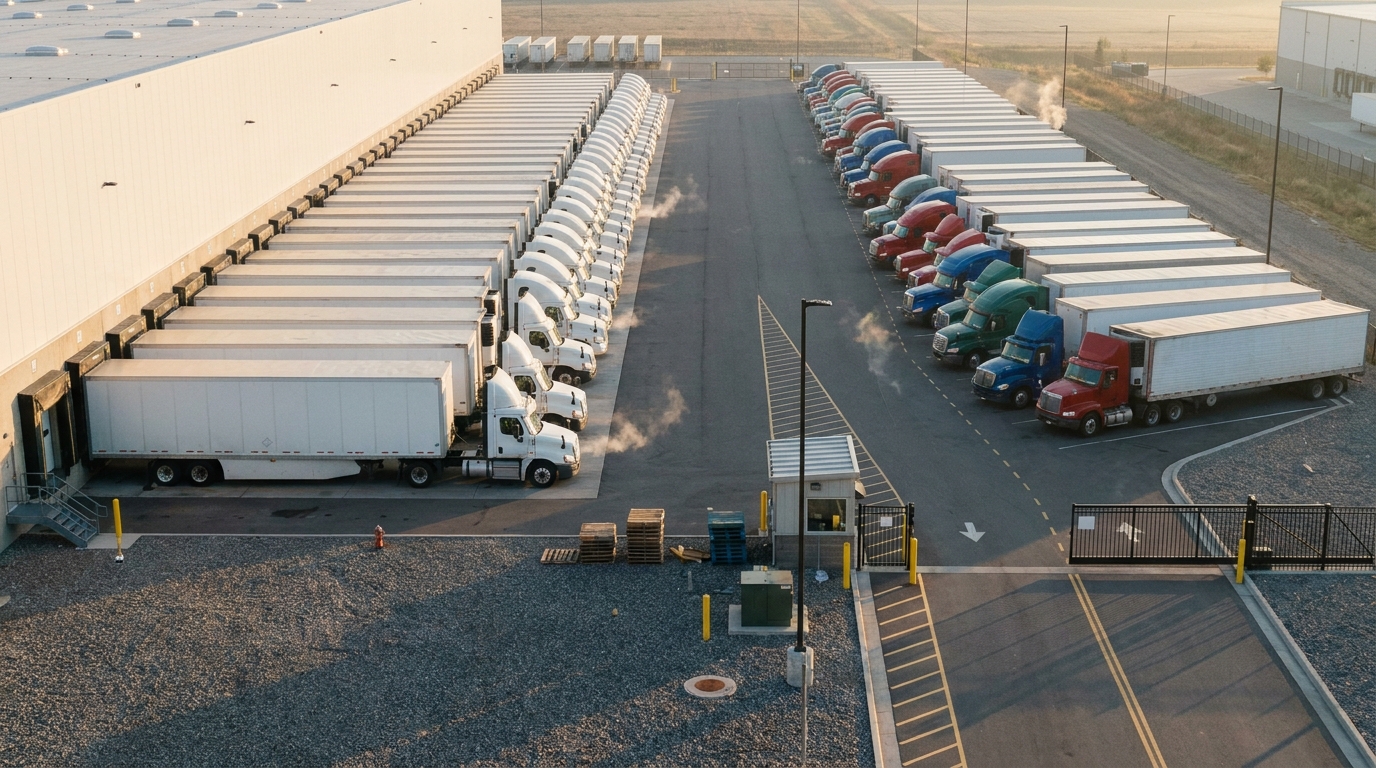
Choosing between a dedicated vs common carrier comes down to a single question: do you have enough steady freight to keep trucks committed to you, or do you need to buy capacity load by load? A dedicated carrier assigns specific trucks and drivers to your freight under a multi-year contract, so capacity is reserved and rates are locked. A common carrier hauls for many shippers on shared capacity and prices each shipment on its own, giving you flexibility but no guarantee a truck will be there when the market tightens. A private fleet is the third option, where you own the trucks and employ the drivers yourself. The right fit depends on your volume, how consistent your lanes are, and how much capacity risk you can tolerate.
Key takeaways
- Dedicated contract carriage commits equipment and drivers to one shipper for guaranteed capacity and fixed rates, in exchange for a long-term volume commitment.
- Common carriers offer flexible, pay-per-load capacity across many shippers, but rates and truck availability swing with the market.
- A private fleet gives you the most control and brand presence, but you absorb all the trucks, drivers, safety, and compliance overhead.
- Dedicated usually costs more per mile than a spot rate, yet can lower total landed cost when reliability and service failures are counted.
- The deciding factor is consistent, repeating volume: steady base-load lanes justify dedicated, thin or seasonal freight does not.

What is a common carrier?
A common carrier is a for-hire trucking company that transports freight for the general public, moving loads for many different shippers on shared capacity and pricing each shipment individually. When you tender a load to a common carrier, you are buying a single trip at the going rate, whether that rate comes from a negotiated contract lane or the spot market that day. This is the default model behind most truckload and less-than-truckload freight, and it is what a freight broker taps into when arranging capacity on your behalf.
The strength of the common-carrier model is flexibility. You commit to nothing beyond the loads you actually ship and can shop the market. The trade-off is that capacity is never reserved for you: in a tight market, trucks get scarce and rates climb fast, and a carrier that hauled your lane last week may not have a truck this week. For shippers with unpredictable or seasonal freight, that flexibility is worth more than any guarantee.
What is dedicated contract carriage?
Dedicated contract carriage is an arrangement where a carrier commits specific trucks and drivers exclusively to one shipper under a long-term contract, usually one to several years. The equipment effectively becomes an extension of your operation: the same drivers run your lanes, often in trailers wrapped in your branding, on a schedule built around your freight. In return, you commit to a minimum level of volume or utilization so the carrier can keep those assets productive.
What you are really buying is certainty. Capacity is reserved regardless of what the broader market does, so you are insulated from spot-rate spikes and truck shortages during peak season. Service tends to be more consistent because the same drivers learn your facilities, your appointment windows, and your customers. Dedicated is common where service reliability is non-negotiable, such as store replenishment, plant-to-plant moves, and time-sensitive distribution. The cost of that certainty is commitment: you pay for the committed capacity whether you fill every truck or not.
What is a private fleet?
A private fleet is trucking capacity a company owns and operates itself, buying or leasing the tractors and trailers, employing the drivers, and taking on full responsibility for safety, maintenance, insurance, and regulatory compliance. Instead of hiring transportation, the shipper becomes the carrier for its own freight. Large retailers, grocers, and manufacturers with dense, steady volume often run private fleets to control service quality and put their brand on the road.
The upside is maximum control and visibility, plus the marketing value of branded trucks. The downside is that you now own everything a carrier normally handles for you: driver recruiting and retention, hours-of-service compliance, DOT safety ratings, equipment cycles, and the risk of empty backhauls. That operational and regulatory load is why many shippers who want dedicated-style capacity choose dedicated contract carriage instead, letting a carrier absorb the driver and compliance burden. Carrier operating authority and safety records are public through the FMCSA, which matters whether you outsource or run your own trucks.
How do dedicated, common, and private fleets compare?
The three models trade off along the same axes: cost structure, capacity assurance, service consistency, flexibility, and how much commitment and overhead you take on. The table below lays out how they typically differ.
| Factor | Dedicated contract carriage | Common carrier | Private fleet |
|---|---|---|---|
| Who owns the trucks | Third-party carrier | Third-party carrier | You |
| Who employs drivers | Carrier | Carrier | You |
| Capacity assurance | Reserved and guaranteed | Not guaranteed, market-dependent | Fully controlled |
| Pricing | Fixed contract rate | Per-load, contract or spot | Internal cost, no markup |
| Per-mile cost | Higher than spot, predictable | Lowest in soft markets, spikes when tight | Varies with utilization |
| Flexibility | Low, committed volume | High, pay per load | Low, fixed assets |
| Commitment | Multi-year contract, minimums | Load by load | Ongoing ownership |
| Overhead you carry | Minimal | Minimal | Full compliance and operations |
| Best fit | Steady, repeating high-volume lanes | Variable, seasonal, or thin freight | Dense volume plus brand and control needs |

When does dedicated make more sense than common carrier?
Dedicated makes sense when you have consistent, repeating volume that keeps trucks moving most of the week on the same lanes. If your freight cycles predictably out of the same origins to the same destinations, dedicated turns that pattern into reserved capacity and a rate you can budget against. The clearest signals are recurring lanes, tight delivery windows, high service expectations, and pain during peak season when common capacity dries up or spot rates spike.
Common carriers or a broker fit better when your freight is seasonal, unpredictable, or spread thinly across many lanes that no single dedicated fleet could keep busy. If your volume cannot reliably fill the committed trucks, you end up paying for empty capacity and the economics turn against you. Many shippers understand this split by looking at how spot and contract freight rates behave across the year: dedicated is the most committed end of the contract spectrum, and it only pays off when your volume is steady enough to honor the commitment.
How do the costs actually compare?
On any single load, a dedicated rate almost always looks higher than a spot common-carrier rate, especially in a soft market where trucks are plentiful and spot prices are low. The honest comparison is not per-mile price, it is total cost across a full year, including service failures, missed delivery windows, expedite premiums, and rate spikes when the market tightens. Dedicated smooths all of that into one predictable number.
Consider a shipper running five outbound truckloads a day, five days a week, on the same regional lanes. On the common-carrier market, those loads might price well below a dedicated rate for much of the year. But during a tight fall peak, spot rates can climb sharply and trucks may not show up at all, forcing costly expedites and late deliveries to key customers. A dedicated arrangement covering those 25 weekly loads locks the rate and the capacity year-round. Whether dedicated wins depends on how often the shipper hits those tight-market conditions and how much a service failure costs its business. For shippers who prefer to keep buying flexibly, understanding how to choose a freight broker is often the better path, since a strong broker can source common-carrier capacity across many carriers at once.
How do you decide which model fits?
Start with your freight profile, not the carrier pitch. Map your lanes, weekly volume by lane, seasonality, and service requirements, then match that pattern to the model. Steady, dense, repeating lanes point toward dedicated. Variable or thin freight points toward common carriers and brokers. Very high, brand-sensitive volume with the appetite to run trucks yourself points toward a private fleet.
A practical sequence for most shippers:
- Quantify each lane: loads per week, direction, and how consistent the volume is month to month.
- Separate your reliable base-load lanes from your variable and seasonal freight.
- Put the base load out for dedicated bids and price the same lanes as common-carrier contract freight to compare total cost, not just per-mile rate.
- Read the dedicated contract for minimum volume commitments, term length, fuel and rate escalators, and exit terms.
- Cover overflow, peaks, and one-off lanes with common carriers or a broker so you are not paying for idle dedicated trucks.
Most mature shippers land on a blend: dedicated for the predictable core, common carriers for everything variable. Before you commit to any model, it helps to understand the mechanics of the freight itself, from what full truckload shipping involves to how carriers price capacity. You can compare providers across models in the directory of long-haul truckload carriers or browse the full National Freight Hub company directory when you are ready to request bids, and the free 3PL RFQ builder helps you structure a clean request before you ask for quotes. Federal freight and mode data from the Bureau of Transportation Statistics can also help you sanity-check lane and market conditions.
Frequently asked questions
What is the difference between a dedicated and a common carrier?
A dedicated carrier commits specific trucks and drivers to one shipper under a long-term contract, so capacity is reserved and rates are fixed. A common carrier hauls freight for many shippers on shared capacity and prices each load individually, so it is more flexible but capacity is not guaranteed.
Is dedicated contract carriage cheaper than using common carriers?
Not on a per-mile basis for any single load. Dedicated usually costs more per mile than a spot common-carrier rate, but it can lower total cost when you factor in reliable capacity, fewer service failures, and no rate spikes during tight markets. It pays off at consistent, high volume, not for occasional shipments.
How much volume do you need to justify a dedicated fleet?
There is no universal threshold, but dedicated tends to make sense when you have steady, repeating lanes that keep trucks moving most of the week. If your freight is seasonal, unpredictable, or spread thinly across many lanes, common carriers or a broker usually fit better.
What is the difference between a dedicated carrier and a private fleet?
With dedicated contract carriage, a third-party carrier owns the trucks, employs the drivers, and manages compliance while committing that capacity to you. With a private fleet, you own or lease the equipment and employ the drivers yourself, taking on full operational and regulatory responsibility.
Can you use both dedicated and common carriers?
Yes, and most large shippers do. A common approach is to put your steady base-load lanes on dedicated capacity and cover overflow, seasonal peaks, and one-off lanes with common carriers or a broker. This blends guaranteed capacity with flexibility.
Do dedicated contracts lock you in?
Yes. Dedicated agreements typically run one to several years and often include minimum volume or utilization commitments, so you pay for the committed capacity whether you fill it or not. Read the minimums, term length, and exit terms closely before signing.
Ready to compare providers?
Search the directory by service and location, save options to your shortlist, and send a clear RFQ.
Related guides
Carrier Vetting: How to Avoid Fraud and Bad Carriers
A step-by-step guide to carrier vetting: verify FMCSA authority and safety, confirm insurance with the insurer, spot red flags, and stop double-brokering.
Shipping Construction Materials to a Jobsite
How construction freight works: matching flatbed and specialized trailers to steel, lumber, pipe, and precast, plus jobsite access, oversize permits, and delivery timing.
Trade Show Shipping and Material Handling
How trade show shipping works, from advance warehouse vs show-site delivery to drayage fees, targeted move-in times, paperwork, and return freight.