
Frozen Food Logistics: Storage and Transport
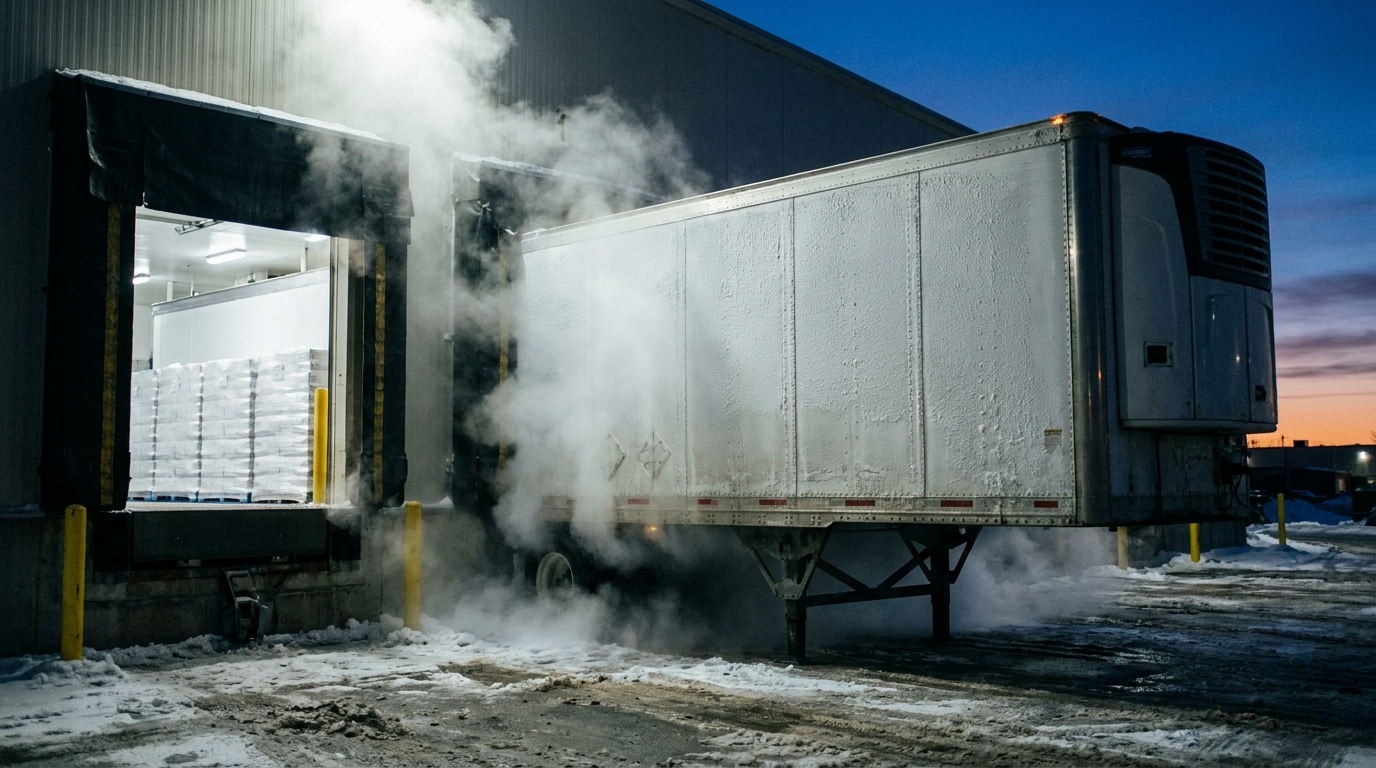
Frozen food logistics is the end-to-end system that keeps food solidly frozen from production to the shelf, holding product at 0°F (-18°C) or colder through freezing, storage, transport, and last-mile delivery. The chain has four handoffs that matter most: freezing product fast at intake, holding it in a frozen warehouse, moving it in refrigerated trailers, and getting it into a retailer or a customer's hands without a temperature break. A failure at any one of those points can cost the whole load, so frozen operations are built around proving the cold held at every step.
Key takeaways
- Frozen food is generally held at 0°F (-18°C) or colder from freezing through delivery; ice cream and some seafood run colder.
- Blast freezing at intake pulls product to frozen fast, forming small ice crystals that protect texture and shelf life.
- Transport uses refrigerated trailers (reefers) that are pre-cooled and set to hold the frozen setpoint, with temperature records to prove it.
- The FDA's FSMA Sanitary Transportation Rule sets general expectations for keeping food safe in transit across shippers, carriers, and receivers.
- A frozen 3PL should offer verified frozen capacity, reefer transport, monitoring, and a documented recall and traceability process.
What temperature does frozen food need to stay at?
Frozen food is generally kept at 0°F (-18°C) or colder across storage and transport, which is the widely used benchmark for holding food frozen safely. Some categories run colder by design: ice cream, novelties, and certain seafood are often held in the -10°F to -20°F range to keep texture stable and slow the quality loss that creeps in near the freezing threshold.
The number that actually protects the product is core temperature, not the air reading on a door display. Product that has been fully frozen and stays at setpoint can ride out brief door openings, but repeated warm-ups and refreezes drive freezer burn and texture damage even when the food is still technically safe. That is why frozen operations track temperature continuously rather than spot-checking it. For a fuller picture of how these stages connect, see our guide to what cold chain logistics is.
Why does blast freezing happen at intake?
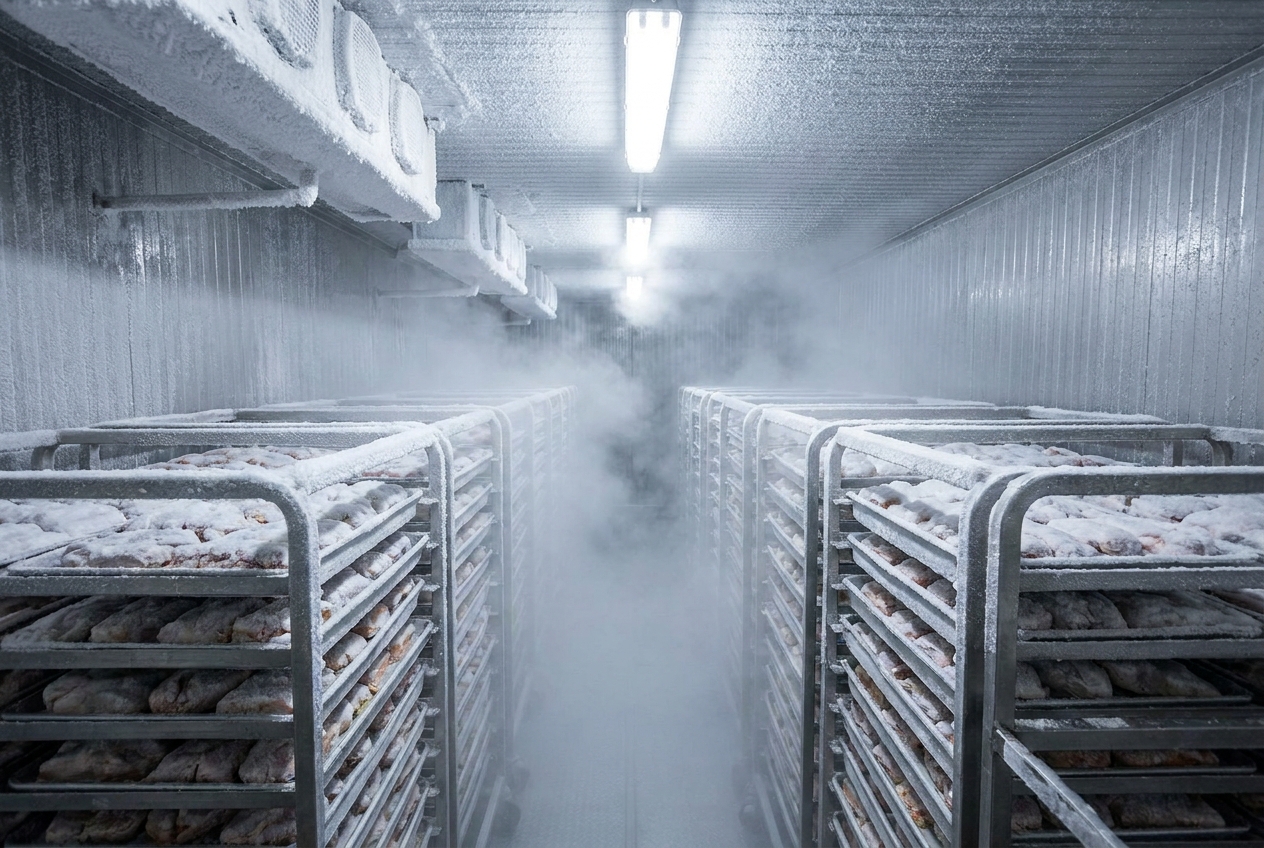
Blast freezing pulls a product's core temperature down to frozen quickly, typically in hours rather than the days a standard freezer takes, by forcing high-velocity cold air over it. It happens at intake because how fast something freezes decides how good it is when it thaws.
Freeze food slowly and large ice crystals form inside the cells, rupturing them so the product turns mushy and loses moisture on thaw. Freeze it fast and the crystals stay small, so texture and yield hold up. Not every product needs a dedicated blast cycle, but freshly cooked, high-moisture, or delicate items usually do. Our explainer on what blast freezing is covers the equipment and cycle times in more depth.
How does reefer transport keep frozen loads cold?
Frozen loads move in refrigerated trailers, known as reefers, running a unit set to hold 0°F or colder for the whole trip. The trailer is a holding box, not a freezer that can rescue warm product, so the sequence around it matters more than the equipment alone.
A clean frozen move follows a repeatable pattern: freeze the product fully before it ships, pre-cool the trailer to setpoint before loading, load quickly with pallets stacked to let air circulate around them, and monitor temperature with recorders or telematics from pickup to delivery. Carriers that haul frozen food are subject to the same federal safety oversight as other interstate motor carriers, which the FMCSA administers. Before a load leaves, a written handoff protocol helps everyone agree on the setpoint and the response if it drifts; our cold transport checklist for food shippers lays out what to confirm.
What does the FSMA Sanitary Transportation Rule require?
The FDA's Sanitary Transportation of Human and Animal Food rule, part of the Food Safety Modernization Act (FSMA), sets general requirements for shippers, carriers, loaders, and receivers to keep food safe while it moves. At a high level it addresses equipment and vehicle design, temperature control during transit, cleaning between loads, training, and recordkeeping.
The rule assigns responsibilities across the parties rather than putting everything on the carrier: the shipper typically specifies the temperature and sanitary conditions, and the carrier operates to them and documents that it did. Because the details and any exemptions depend on your product and role, confirm the specifics against the FDA's FSMA guidance rather than relying on a summary.
Frozen vs refrigerated handling: what is the difference?
Frozen logistics holds product solid at roughly 0°F (-18°C) or below, while refrigerated or chilled logistics holds fresh product above freezing, commonly around 33°F to 41°F. That gap changes almost every handling decision, from dock time to shelf life.
| Factor | Frozen handling | Refrigerated (chilled) handling |
|---|---|---|
| Target temperature | Around 0°F (-18°C) or colder | Roughly 33°F to 41°F, above freezing |
| Product state | Solidly frozen | Fresh, must not freeze |
| Typical shelf life | Weeks to many months | Days to a few weeks |
| Transit-time tolerance | More forgiving on longer hauls | Tight; time and temperature critical |
| Main quality risk | Freezer burn from partial thaw and refreeze | Spoilage, or freeze damage if it drops too low |
| Dock discipline | Minimize door-open exposure | Minimize door-open time and total transit |
Neither is simply harder; they fail in different ways. Frozen product forgives a longer haul but punishes repeated warm-ups, while chilled product forgives a brief warm-up but punishes slow transit and any accidental freeze. Many food brands run both, and our guide comparing frozen, refrigerated, and chilled storage goes deeper on where each line belongs.
How does frozen distribution and last-mile delivery work?
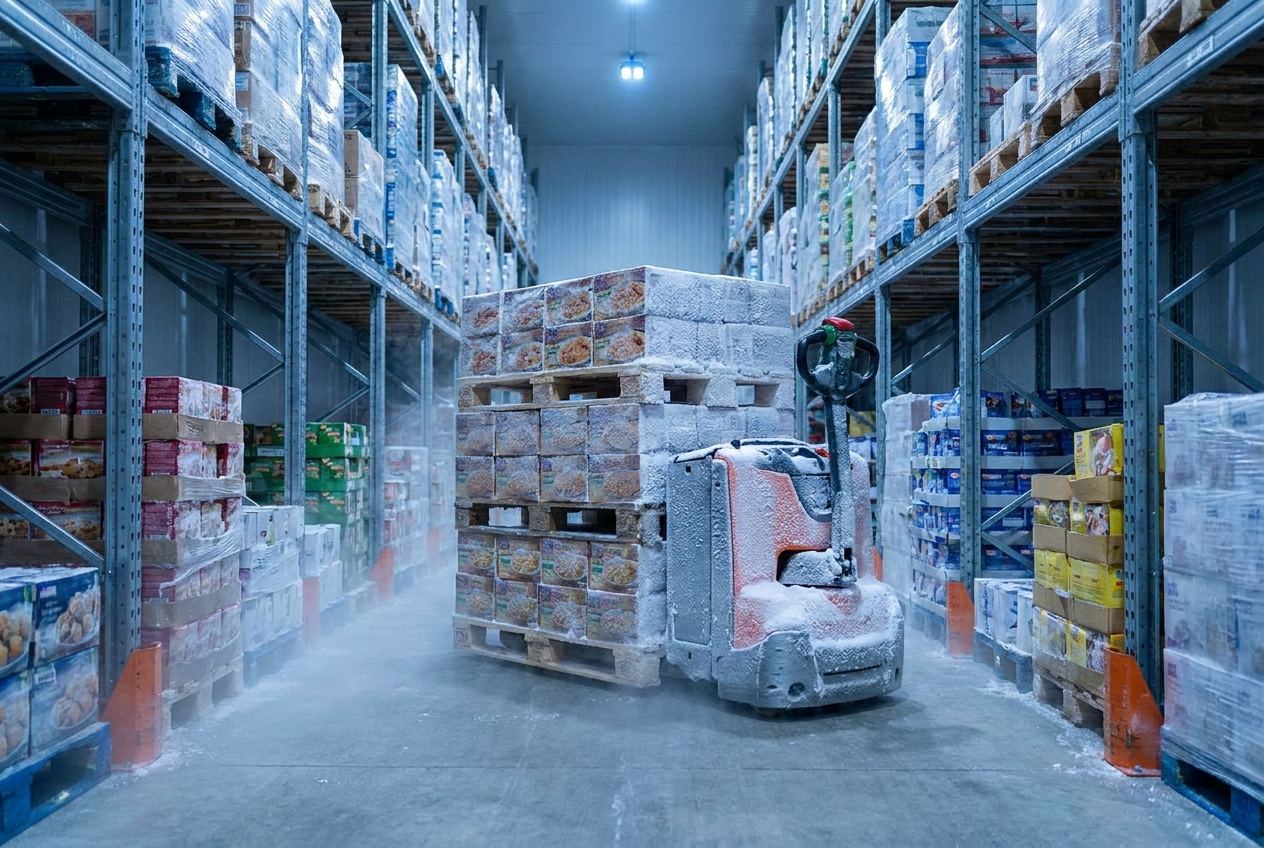
Frozen distribution moves product from a central frozen warehouse to regional facilities and then to stores or customers, keeping it at setpoint through every transfer and dock. The weak points are the seams: the moments product sits on a dock, changes trailers, or waits in a delivery vehicle.
Consider a worked example. A pallet of frozen entrees leaves a frozen distribution center at 0°F, rides a pre-cooled reefer to a regional cross-dock, and transfers to a local delivery route. If it sits 40 minutes on an unrefrigerated dock during the transfer on a warm day, the surface layer begins to soften even though the core is still frozen, and that partial thaw is exactly what causes freezer burn once it refreezes. Well-run last-mile frozen delivery fights this with cold-holding equipment, tight transfer windows, insulated packaging for smaller drops, and monitoring that flags a drift before it ruins the load. Warehousing and handling cost money at each node, and our warehouse cost calculator helps you estimate the storage side of that network.
How do you choose a frozen food 3PL?
Choose a frozen food 3PL on proven cold-chain capability, not just available pallet positions. The core checklist: verified frozen storage capacity at your required temperatures, blast-freezing capability if your product needs it, reefer transport with temperature monitoring, FSMA-aligned sanitary practices, and a documented recall and traceability process you can audit.
Ask concrete questions. What temperatures can you hold and prove, and how is that recorded? Do you blast freeze in-house or outsource it? How do you handle a reefer breakdown or a temperature excursion in transit? What is your recall procedure and how fast can you trace a lot? Get references from shippers with similar products and volumes. To compare providers side by side, browse cold storage and warehousing companies and food and beverage 3PLs in the directory, and shortlist the ones that can document the cold held at every handoff.
Frequently asked questions
What temperature is frozen food stored at?
Frozen food is generally held at 0°F (-18°C) or colder throughout storage and transport. Some products such as ice cream and certain seafood are held colder, often in the -10°F to -20°F range, to protect texture and shelf life.
What is blast freezing and why does it happen at intake?
Blast freezing uses high-velocity cold air to pull a product's core temperature down to frozen quickly, usually within hours rather than days. Doing it at intake forms smaller ice crystals, which protects texture and prevents the slow-freeze cell damage that hurts quality.
How is frozen food kept cold during transport?
Frozen loads move in refrigerated trailers, called reefers, with the unit set to hold 0°F or colder. Product is pre-frozen before loading, the trailer is pre-cooled, pallets are loaded to allow airflow, and many shippers use temperature recorders or telematics to prove the setpoint held door to door.
What does the FSMA Sanitary Transportation Rule require?
The FDA's Sanitary Transportation of Human and Animal Food rule sets general requirements for shippers, carriers, and receivers to keep food safe in transit, covering equipment design, temperature control, cleaning, and recordkeeping. Consult the FDA's FSMA guidance for the specifics that apply to your operation.
What is the difference between frozen and refrigerated logistics?
Frozen logistics holds product solid at roughly 0°F (-18°C) or below, while refrigerated (chilled) logistics holds fresh product above freezing, commonly around 33°F to 41°F. Frozen handling tolerates longer transit and shorter door-open exposure; chilled handling is tighter on time and gentler on the product.
How do I choose a frozen food 3PL?
Look for verified frozen storage capacity at your required temperatures, blast-freezing capability if you need it, reefer transport and temperature monitoring, FSMA-aligned sanitary practices, and a clear recall and traceability process. Ask for references from shippers with similar products and volumes.
Ready to compare providers?
Search the directory by service and location, save options to your shortlist, and send a clear RFQ.
Related guides
What Is a Temperature Excursion?
A temperature excursion is any time a temperature-sensitive product drifts outside its approved range. Here is what causes them, how to detect and respond, and how to prevent them.
Cold Chain Packaging: Gel Packs, Dry Ice, and PCMs
How cold chain packaging works: the refrigerants, insulation, and qualification steps that keep a shipment inside its temperature band from pickup to delivery.
Pharmaceutical Cold Chain: A Compliance Guide
How the pharmaceutical cold chain keeps drugs within validated temperature bands, from 2-8C refrigerated to ultra-cold, under Good Distribution Practice.