
Flatbed Load Securement and Tarping Guide
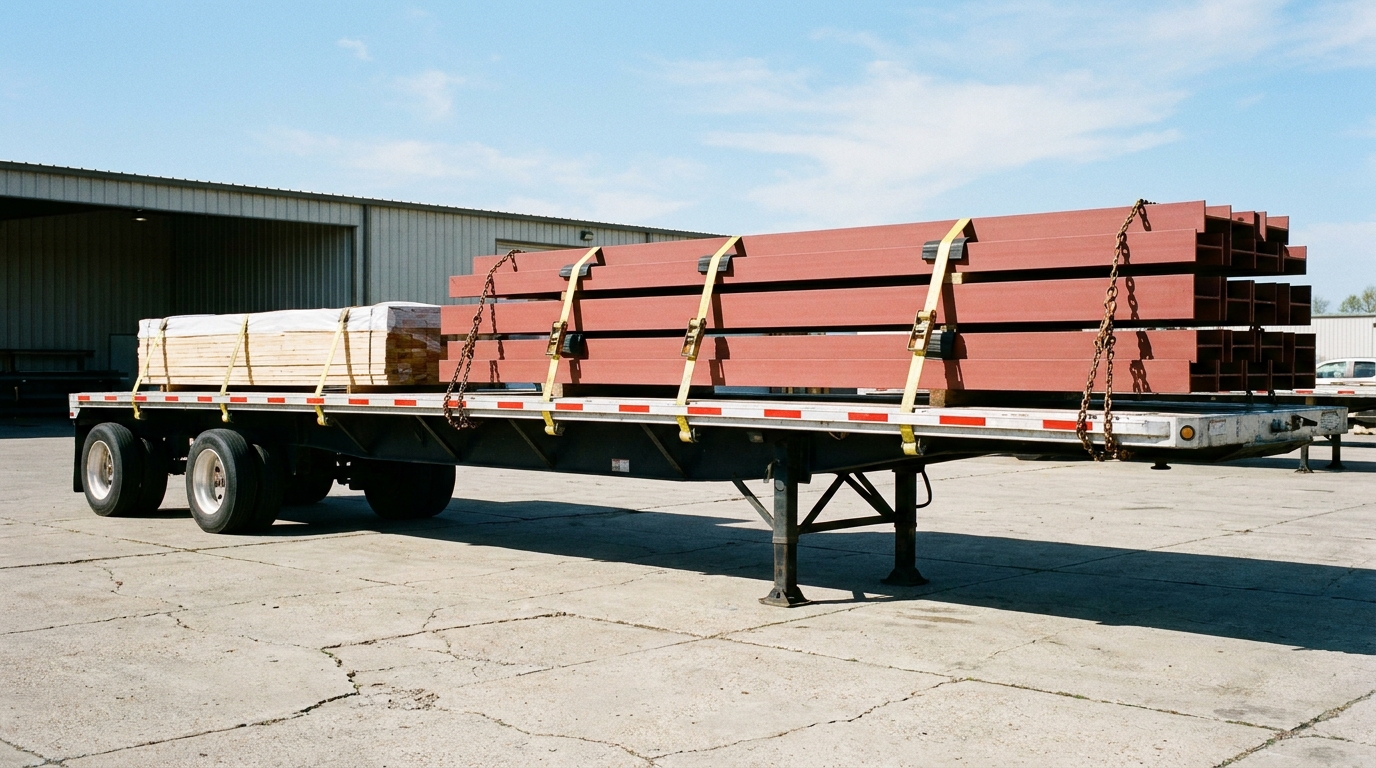
Flatbed securement is the set of straps, chains, binders, blocking, and edge protection that hold freight on an open deck so it cannot slide, tip, or fall off in transit. Because a flatbed has no walls or roof, every load is held by tiedowns working against the cargo's own weight and the forces of braking, turning, and acceleration. The governing standard is the FMCSA cargo securement rules, and the single number that drives most decisions is working load limit: the combined rated capacity of your tiedowns must be at least half the weight of the load.
Key takeaways
- The aggregate working load limit of all tiedowns must equal at least 50 percent of the cargo weight.
- FMCSA sets a minimum tiedown count by article length and weight, but load shape usually requires more.
- Straps suit finished and palletized goods; chains and binders suit steel, machinery, and sharp-edged freight.
- Edge protection is required wherever a sharp corner could cut or crush a tiedown.
- Weather-sensitive freight such as lumber and drywall must be tarped; steel and pipe usually ride open.
What do the FMCSA cargo securement rules require?
The FMCSA cargo securement rules set the legal floor for how any load on a commercial vehicle, including a flatbed, must be held. They require that cargo cannot shift or fall under normal driving forces, that tiedowns and anchor points are in good condition, and that the combined strength of the system meets a defined threshold tied to the load's weight. The full text lives in the Federal Motor Carrier Safety Administration regulations, with commodity-specific rules for metal coils, logs, pipe, and heavy machinery. You can read the standard directly at the FMCSA.
Two ideas carry most of the weight in practice: a minimum number of tiedowns, and an aggregate working load limit. Get both right and a load will pass inspection and stay put.
What is working load limit and the aggregate rule?
Working load limit, or WLL, is the maximum load a strap, chain, or binder is rated to hold in normal use, marked on the component by its manufacturer. It is deliberately set below the component's breaking strength, so the rating already includes a safety margin. The aggregate WLL of a securement system is the sum of every tiedown's rating, counting each end that is anchored.
The rule of thumb that flows from the regulation is simple: add up the working load limits of all your tiedowns, and that total must be at least half the weight of the cargo. A 40,000 pound load therefore needs tiedowns totaling at least 20,000 pounds of aggregate WLL. If a single strap is rated at 3,335 pounds WLL, you would need at least six of them, and often more once you account for the load's length and how it wants to move.
How many tiedowns does a flatbed load need?
FMCSA sets a minimum count based on article length and weight. An article up to 5 feet long and 1,100 pounds needs at least one tiedown. Up to 10 feet, it needs two. Beyond 10 feet, add one more tiedown for every additional 10 feet of length or fraction of it. A 32-foot beam, for example, falls into the four-tiedown minimum before you even check the weight math.
Treat the count as a floor, not a target. The aggregate WLL rule can push the number higher, and irregular or top-heavy loads need extra tiedowns to control tipping, not just sliding. When the two rules disagree, use whichever demands more.
Straps, chains, and binders: which do you use?
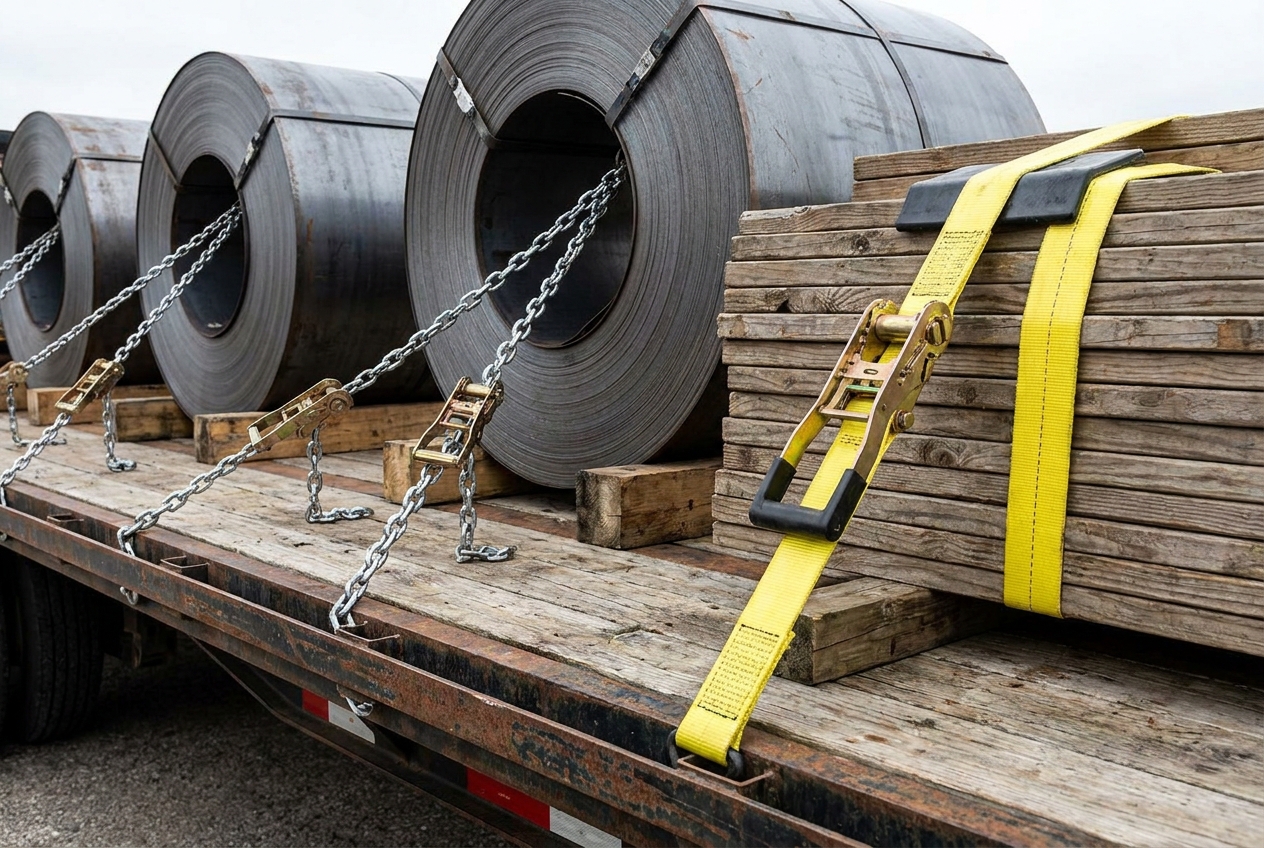
The securement hardware splits into two families. Webbing straps with ratchets are fast, light, and gentle on finished surfaces, so they suit palletized freight, boxed goods, coils that could be scratched, and lumber. Chains with load binders are stronger and abrasion-resistant, so they suit steel plate, structural steel, machinery, concrete pipe, and anything heavy with sharp edges. A ratchet binder tightens a chain in a controlled way and holds tension better than a lever binder on a long haul.
| Tiedown method | Typical use | Strengths | Watch for |
|---|---|---|---|
| Webbing straps with ratchets | Palletized goods, lumber, coils, finished products | Fast, light, protects surfaces, easy to inspect | Cuts on sharp edges without corner protection; UV and abrasion wear |
| Chain with ratchet binder | Steel, machinery, pipe, heavy equipment | High working load limit, abrasion resistant | Can mar soft surfaces; heavier to handle; must match chain grade to load |
| Chain with lever binder | Heavy loads where speed matters | Quick to set | Stored energy on release; less fine tension control than a ratchet binder |
| Blocking and bracing | Loads that could roll or slide, plus coils and rounds | Stops motion directly, supports tiedowns | Must be sized and secured; not a substitute for enough tiedowns |
Why does edge protection matter?
Edge protection is a corner guard set between a tiedown and any sharp cargo edge, and FMCSA requires it wherever an edge would cut or abrade a tiedown. Its job is twofold: it stops a steel corner or a band edge from slicing through a strap, and it spreads the clamping force so tension is not concentrated on one line of webbing. Skipping edge protection is one of the most common reasons a strap parts on the highway, because a strap can look fine at the yard and fail hours later once vibration works the edge into it. Steel plate, banded bundles, and machinery frames almost always need it.
When do you tarp a flatbed load?
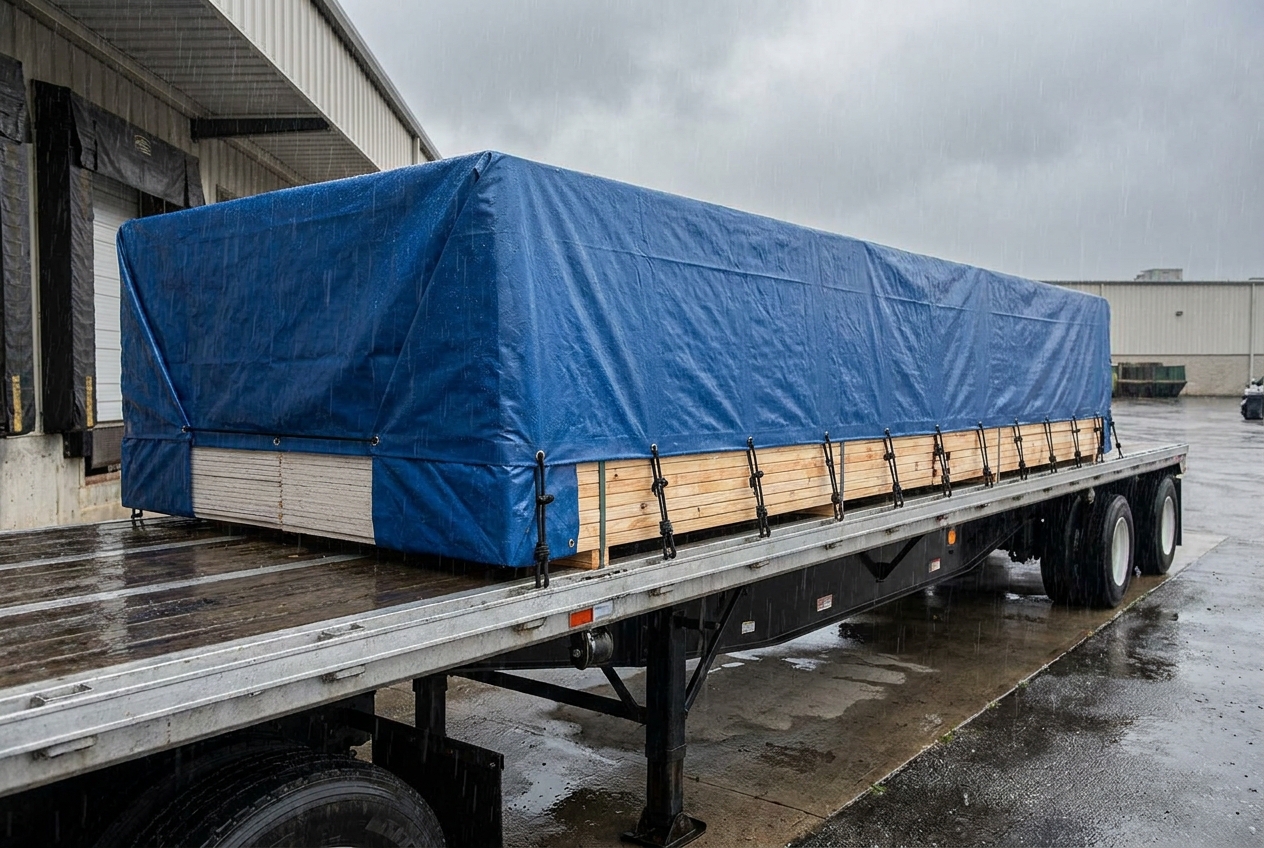
Tarp any freight that rain, road spray, or sun exposure would damage over a multi-day haul. Lumber, drywall, insulation, finished building products, and machinery with exposed electronics or unpainted surfaces all get tarped. Weatherproof freight such as steel plate, concrete pipe, and sealed equipment usually rides open. Tarps add labor, time, and cost, and they are heavy and awkward, so the tarping requirement should be stated on the bill of lading before the truck is dispatched rather than discovered at pickup.
A tarped load still has to be secured first. Tarps are held with bungees and rub rails and are not a securement device. The straps or chains do the holding; the tarp only keeps the weather off. On oversized or unusually shaped freight, tarping and securement get harder together, which is covered in the guide to shipping oversized freight.
A worked example: securing a 44,000 pound coil load
Say you are shipping four steel coils totaling 44,000 pounds, eye to the sky, on a standard 48-foot flatbed. The aggregate WLL rule requires tiedowns summing to at least 22,000 pounds. Metal coils also fall under a commodity-specific FMCSA rule, so each coil needs tiedowns arranged to stop it rolling and shifting, plus timber or a coil rack for blocking. Using grade 70 chain rated near 4,700 pounds WLL per leg, you would run enough chains that the total rated capacity clears 22,000 pounds with margin, and you would add blocking under each coil. This is why coil, pipe, and machinery loads almost always use chain rather than webbing: the weight and the edges both point that way.
How does securement affect choosing a flatbed carrier?
Securement is a skill, not just a set of straps, so it belongs in how you vet a carrier. Ask how the driver plans to secure and tarp your specific commodity, whether they carry enough rated tiedowns and edge protection for the weight, and how they handle a strap that loosens mid-route. A carrier that talks fluently about aggregate WLL and commodity rules is signaling competence. You can compare providers on the flatbed trucking directory, review deck and trailer options in the trailer types guide, and shortlist candidates through the logistics company directory. For dense or heavy freight, running the numbers early with the dimensional weight calculator helps you frame the load before you request quotes.
Good securement protects your freight, keeps the driver legal at every inspection, and prevents the roadside delays a failed load causes. Confirm the plan before dispatch, put the tarping requirement in writing, and verify the carrier's tiedown ratings match your load's weight.
Frequently asked questions
What is the working load limit rule for flatbed securement?
Under the FMCSA cargo securement rules, the aggregate working load limit of all tiedowns holding a load must be at least half the weight of the cargo being secured. Working load limit is the rated safe capacity of a strap, chain, or binder, marked by the manufacturer, and is a fraction of the component's breaking strength.
How many tiedowns does a flatbed load need?
The FMCSA minimum is one tiedown for an article up to 5 feet long and 1,100 pounds, two tiedowns up to 10 feet, and one more for every additional 10 feet or fraction. That is a floor. The aggregate working load limit rule and the shape of the load often require more.
Straps or chains for a flatbed load?
Use webbing straps for palletized, boxed, coiled, or finished goods that could be dented, and use chains with load binders for steel, machinery, pipe, and anything with sharp edges or high weight. Many mixed loads use both. The choice comes down to the cargo's weight, edges, and surface.
When does a flatbed load need to be tarped?
Tarp any freight that rain, road spray, or sun would damage: lumber, drywall, insulation, machinery with exposed electronics, and most finished building products. Steel, concrete pipe, and weatherproof equipment usually ship open. The bill of lading or the shipper should state the tarping requirement up front.
What is edge protection and why does it matter?
Edge protection is a corner guard placed between a tiedown and a sharp cargo edge. It stops the edge from cutting or crushing a strap and spreads the clamping force. FMCSA requires it whenever an edge would cut or abrade a tiedown, and skipping it is a common cause of a strap failing in transit.
Who is responsible if a flatbed load is not secured correctly?
The driver and motor carrier are legally responsible for securement under FMCSA rules and are the ones cited at a roadside inspection. Shippers still share practical risk: loading instructions, blocking, and accurate weight and dimension data all affect whether a load can be secured safely.
Ready to compare providers?
Search the directory by service and location, save options to your shortlist, and send a clear RFQ.
Related guides
Carrier Vetting: How to Avoid Fraud and Bad Carriers
A step-by-step guide to carrier vetting: verify FMCSA authority and safety, confirm insurance with the insurer, spot red flags, and stop double-brokering.
Dedicated vs Common Carrier: Which Fits
How dedicated contract carriage, common carriers, and private fleets compare on cost, capacity, and commitment, and when your volume justifies dedicated.
Shipping Construction Materials to a Jobsite
How construction freight works: matching flatbed and specialized trailers to steel, lumber, pipe, and precast, plus jobsite access, oversize permits, and delivery timing.