
Reverse Logistics: Returns, Recalls, and Recycling
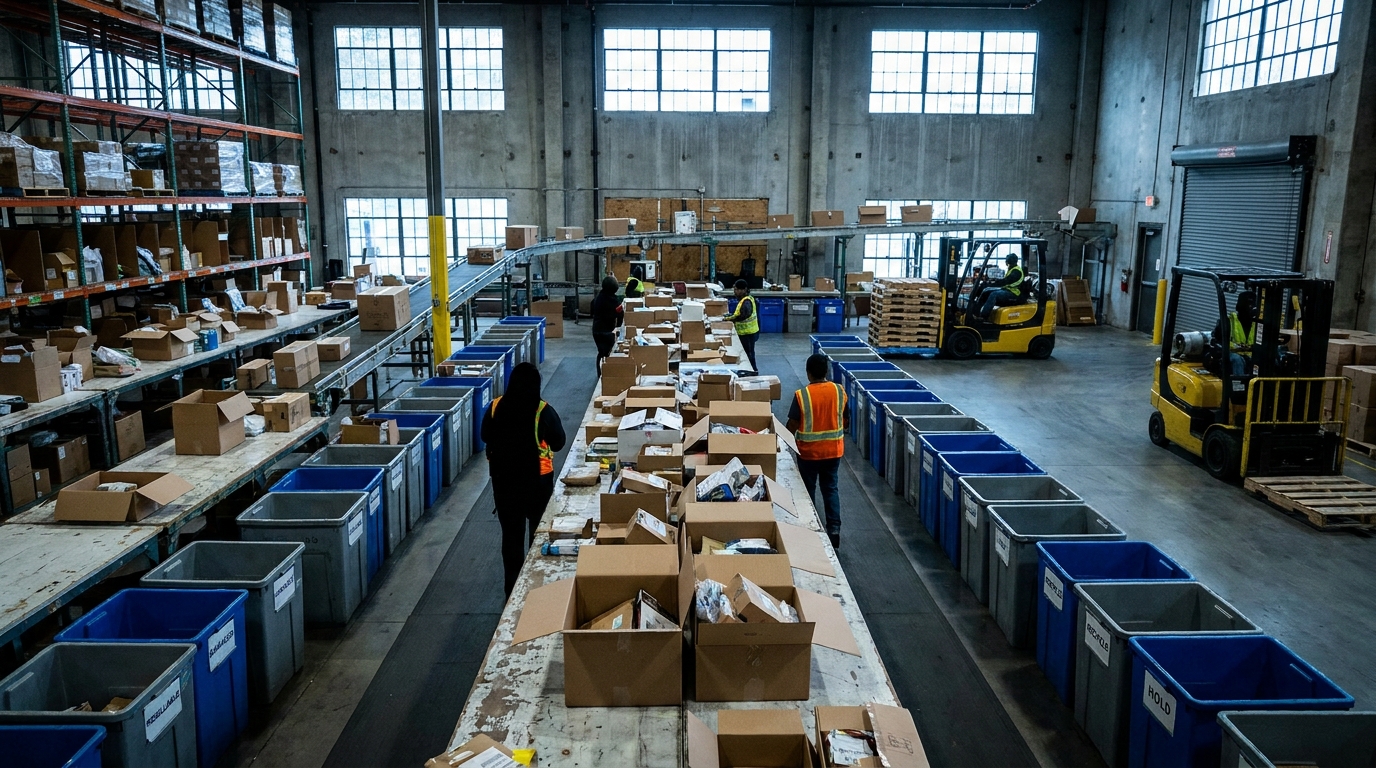
Reverse logistics is the movement of goods backward through the supply chain, from the customer or point of sale back toward the seller, manufacturer, or a recycler. It covers returns, recalls, repairs and refurbishment, redistribution of unsold stock, recycling, and final disposal. Where forward logistics pushes product out to buyers, reverse logistics decides what happens to everything that comes back and how much of its value you recover. For shippers and ecommerce brands, that decision is often the difference between a return that costs you twice and one that recaptures most of the unit's worth.
Key takeaways
- Reverse logistics is the backward flow of goods: returns, recalls, repairs, redistribution, recycling, and disposal.
- The disposition decision (restock, refurbish, liquidate, recycle, or dispose) sets the value you recover on every returned unit.
- Processing a return frequently costs more per unit than the original outbound shipment, so grading speed and clear rules matter.
- Recalls are a distinct, time-sensitive branch with traceability, documentation, and controlled-disposal requirements.
- Routing goods to refurbishment or recycling turns a pure cost center into partial value recovery and supports sustainability goals.
What is reverse logistics?
Reverse logistics is the set of processes that manage goods flowing in reverse: away from the end customer and back toward the seller, manufacturer, or a downstream recycler or disposal point. It is the mirror image of forward distribution, but it is harder to run because the inputs are unpredictable. You do not know in advance which units will come back, in what condition, or how many will arrive in a given week.
Forward logistics moves known quantities of new product in batched, planned flows. Reverse logistics receives single units in mixed condition, each of which needs to be inspected and routed individually. That shift, from batch to unit and from predictable to variable, is why returns handling is labor-intensive and why a strong process pays for itself. Many brands treat it as part of their broader warehousing and 3PL operation rather than a separate silo.
What flows backward through reverse logistics?
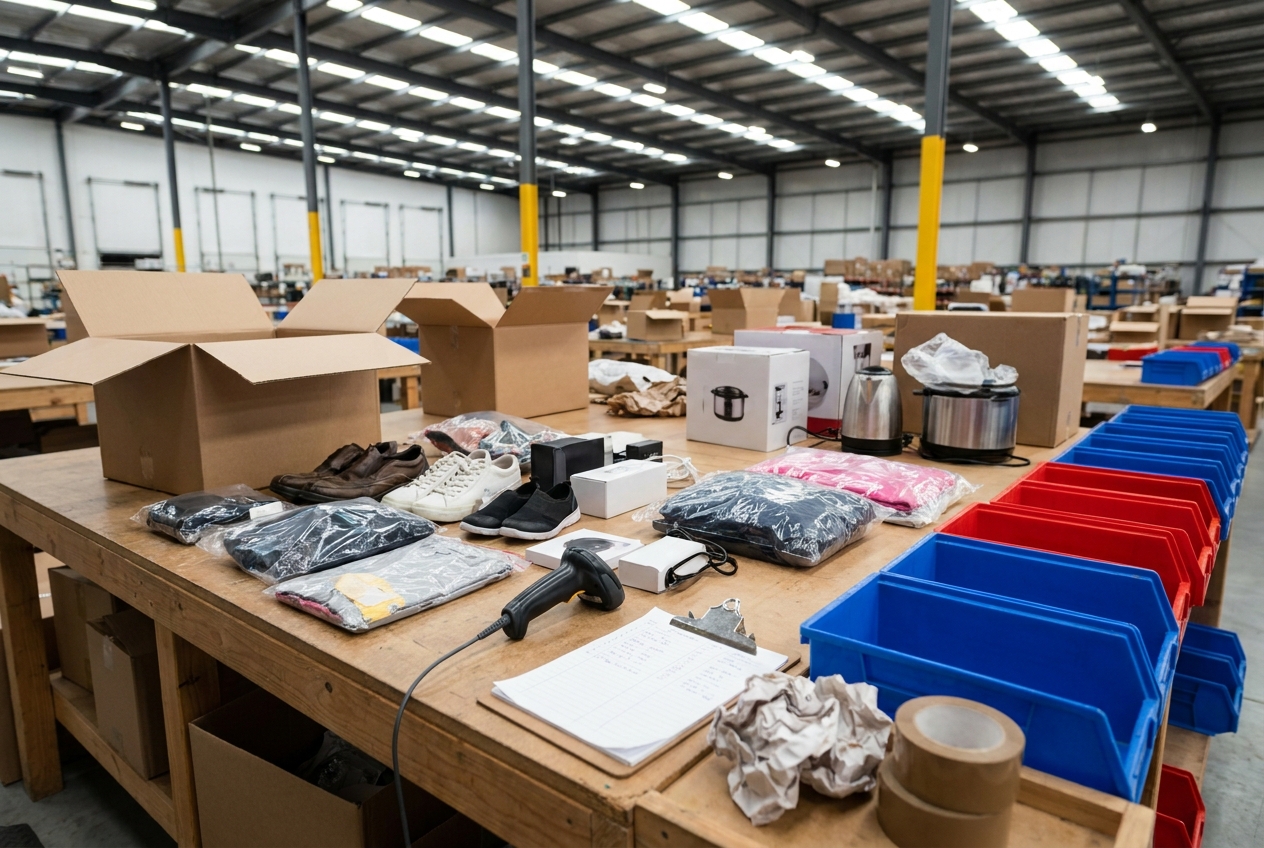
Six main streams move in reverse, and most operations handle several at once. Naming them helps you design the right process for each.
- Returns: customer returns from ecommerce and retail, the largest and most frequent stream for most brands.
- Recalls: product pulled from the market for a safety or quality defect, on a deadline and with documentation.
- Repairs and refurbishment: warranty and service returns that get fixed or reconditioned and sent back into use.
- Redistribution: unsold or overstock inventory pulled back from stores or fulfillment nodes and reallocated.
- Recycling: end-of-life products and packaging broken down for material recovery.
- Disposal: items that cannot be resold, reused, or recycled and must be discarded, sometimes under regulated conditions.
What are the stages of the reverse logistics process?
Reverse logistics runs in stages: authorization, collection and transport, receiving and inspection, the disposition decision, and value recovery or disposal. Each stage adds handling cost, so the goal is to move a unit to its final path as quickly and correctly as possible.
It usually starts with authorization, where a return or recall is approved and a reason code is captured. Then comes collection and transport back to a returns facility. On arrival, receiving and inspection grade the unit's condition. The disposition decision assigns a path, and finally value recovery or disposal executes it, whether that means restocking, refurbishing, liquidating, recycling, or discarding. The faster and more consistent the grading step, the less inventory sits idle losing value.
How does the disposition decision work?
The disposition decision is the core of reverse logistics: for each returned unit, choose the path that recovers the most net value given its condition, resale value, warranty status, and any category rules. Getting this right, at speed and at scale, is what separates a returns operation that leaks money from one that recaptures it.
Condition grading typically sorts units into new or like-new, lightly used or open-box, defective but repairable, and unrecoverable. A high-value electronics return in like-new condition should be restocked or refurbished, not liquidated. A low-value item that costs more to inspect and repackage than it is worth may be better recycled or written off. The table below compares the main paths.
| Disposition path | Best fit | Value recovered | Typical trade-off |
|---|---|---|---|
| Restock as new | Unopened or like-new, still in season and in demand | Highest, near full price | Requires strict grading so no used item slips into new stock |
| Refurbish or repair | Functional defects, higher-value goods under warranty | Moderate to high | Labor and parts cost; needs a certified process |
| Liquidate or resell secondary | Open-box, overstock, out-of-season items | Partial, often a fraction of retail | Channel access and brand-protection controls needed |
| Recycle for materials | End-of-life, damaged beyond repair, packaging | Low, material value only | Requires a recycler relationship and clean sorting |
| Dispose | Unsafe, contaminated, or regulated items with no path | None, net cost | May require documented or hazmat-compliant disposal |
How much does reverse logistics cost, and where is the value recovery?
Per unit, processing a return often costs more than the original outbound shipment, because a single item ships back on its own rather than in a full truckload and then absorbs inspection, grading, and repackaging labor before it can sell again. Value recovery is what offsets that cost, and it swings widely with how fast and how accurately you route each unit.
Consider a worked example. A brand receives back a mid-range consumer electronics unit that originally sold for a couple hundred dollars. If it is graded like-new within a day or two and restocked, most of that value is preserved, minus modest handling. If the same unit sits ungraded for weeks, the model gets superseded, and it eventually goes to liquidation, the brand may recover only a small fraction of retail. Same product, very different outcome, driven almost entirely by grading speed and disposition discipline. This is also why brands model these flows alongside outbound costs using a warehouse cost calculator before committing to a returns process.
How do product recalls change reverse logistics?
A recall is a time-sensitive reverse flow triggered by a safety or quality defect, and it demands controls a routine return does not: lot-level traceability, fast retrieval, documented handling, and controlled disposal or rework. Recalls run against a clock and against regulators, so speed and paperwork both matter.
Recall-capable operations keep separate quarantine areas so affected lots cannot mix back into sellable stock, maintain an audit trail of what came back and where it went, and follow the retrieval and disposal path the recall requires. For food and beverage, recall handling connects to broader food-safety obligations; the U.S. Food and Drug Administration explains the framework under the Food Safety Modernization Act. If recalled goods include hazardous materials, the return transport itself falls under carrier rules from the Federal Motor Carrier Safety Administration, so provider capability here is not optional.
What role do repair and refurbishment play?
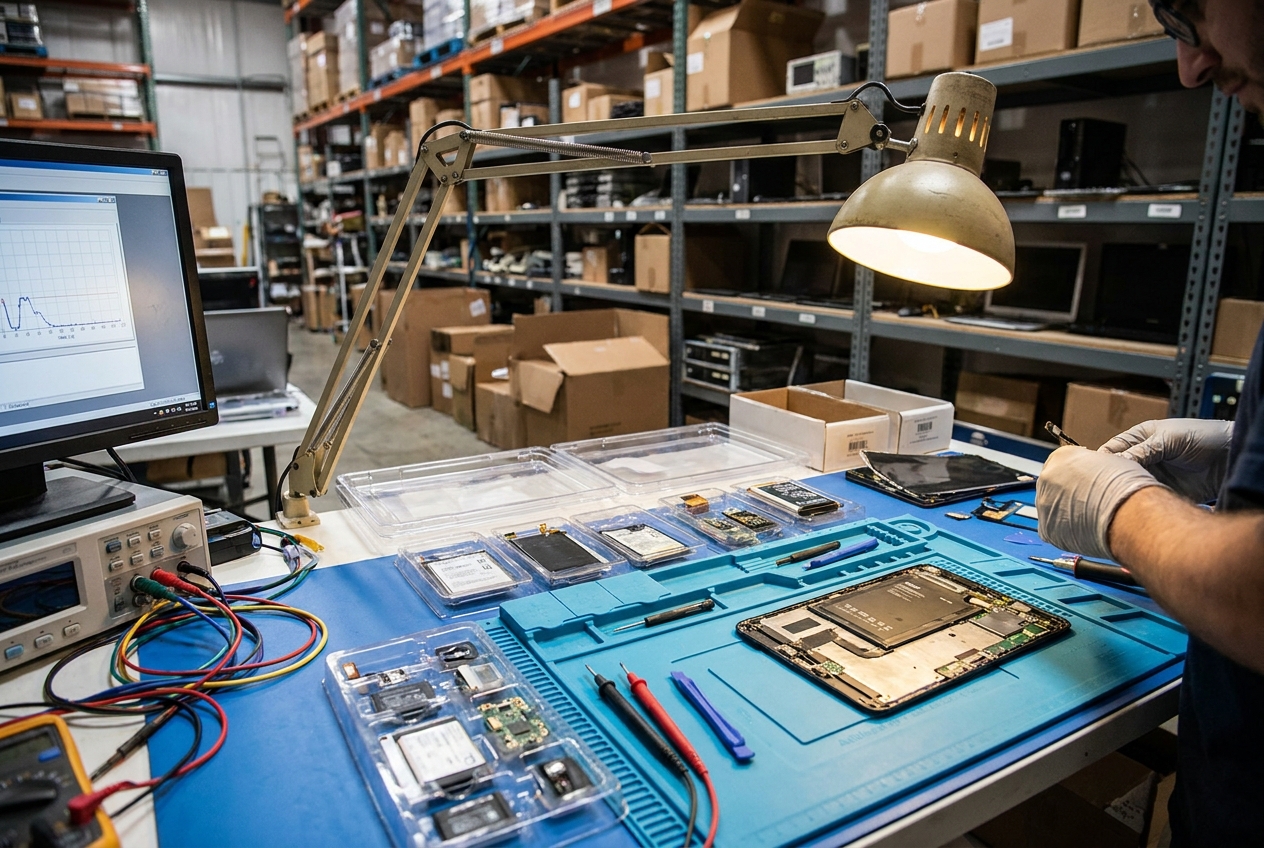
Repair and refurbishment recover value from functional defects by fixing or reconditioning a unit and returning it to service or to a resale channel, rather than writing it off. For higher-value goods under warranty, it is frequently the highest net-value path after a straight restock.
A working refurbishment process needs a defined test-and-repair procedure, a source for replacement parts, and clear grading so a refurbished unit is labeled honestly and not sold as new. Done well, it feeds a legitimate open-box or certified-refurbished channel that protects the brand while recapturing revenue. Done poorly, it becomes a bottleneck where units pile up waiting on parts and lose value by the week.
How does redistribution recover value from unsold stock?
Redistribution pulls unsold, overstock, or seasonal inventory back from stores or fulfillment nodes and reallocates it to where it can sell, rather than letting it sit dead. It is reverse logistics without a defect: the product is fine, but it is in the wrong place.
A common case is a fulfillment network where one node overstocks an item that is selling out at another. Rebalancing that inventory, sometimes across a 3PL network, keeps stock productive and avoids markdowns. The trade-off is transport cost, so redistribution only makes sense when the recovered margin beats the freight to move it.
How does reverse logistics support sustainability?
Reverse logistics supports sustainability by routing returned and end-of-life goods to refurbishment, resale, or materials recycling instead of landfill, which keeps usable products and raw materials in circulation and reduces waste. It is one of the more direct ways a supply chain can shrink its environmental footprint while recovering some value.
Refurbishing a unit avoids the emissions of manufacturing a replacement. Recycling recovers materials that would otherwise be extracted new. Facilities can also cut the energy footprint of the returns operation itself; the U.S. Environmental Protection Agency's Energy Star program offers benchmarking for warehouse efficiency. For many brands, reverse logistics is where extended producer responsibility and take-back commitments actually get executed.
How is ecommerce returns management different?
Ecommerce returns management is the highest-volume, most consumer-facing slice of reverse logistics, defined by frequent single-unit returns, customer expectations for fast refunds, and reason codes that feed back into product and sizing decisions. It is where most brands feel reverse logistics first and hardest.
The differences from other reverse flows are volume and pace: many small returns, each needing a quick grade and a fast refund to keep customers happy, plus data capture on why items came back. For a deeper operational playbook on that specific stream, see the guide to ecommerce returns management. The same grading discipline applies, but at a scale where small per-unit inefficiencies add up quickly.
What special handling do regulated goods need?
Regulated goods such as medical devices, pharmaceuticals, food, and hazardous materials need category-specific controls in reverse: chain-of-custody records, quarantine, temperature or safety compliance, and documented disposal. Returning these products is not just a logistics task, it is a compliance task.
Medical devices, for example, carry traceability and handling requirements that a general returns process is not built for; the guide to medical device logistics covers those controls in detail. Hazardous materials add transport and disposal rules on top. The practical takeaway: match the provider to the product category, because a general reverse-logistics operation may not be authorized or equipped to handle regulated returns.
How do you choose a reverse logistics provider?
Choose a reverse logistics provider on grading speed, disposition transparency, recovery relationships, traceability, and category fit, not on headline price alone, because a cheap operation that grades slowly and liquidates everything will cost you more in lost value. Ask concrete questions and compare answers.
- Grading speed: how many days from receipt to a disposition decision, on average and at peak?
- Disposition rules: what is the written logic for restock versus refurbish versus liquidate, and can you set thresholds?
- Recovery channels: what secondary-market and recycling relationships exist, and how do they protect your brand?
- Traceability and reporting: can they give lot-level tracking and a recovery-rate report you can audit?
- Category capability: do they support recall quarantine, hazmat, cold chain, or medical-device controls if you need them?
You can compare specialized providers on the reverse logistics directory and shortlist ones whose capabilities match your product mix before you request quotes.
What metrics should you track in reverse logistics?
Track the metrics that connect handling to recovered value: recovery rate per unit, average days to disposition, restock rate, and cost to process a return. Together they tell you whether your reverse operation is preserving value or leaking it.
Recovery rate, the share of a returned unit's original value you get back, is the headline number. Days to disposition explains most of the variance in it, because value decays while units wait. Restock rate shows how much comes back sellable, and cost per return keeps the whole thing honest against the value you recover. If recovery rate is falling, days to disposition is usually the first place to look.
Frequently asked questions
What is reverse logistics in simple terms?
Reverse logistics is everything that happens to a product after it moves backward from the customer or point of sale toward the seller, manufacturer, or a recycler. It covers returns, recalls, repairs, refurbishment, redistribution of unsold stock, recycling, and final disposal, and it decides how much of each unit's value you recover.
What is the difference between forward and reverse logistics?
Forward logistics pushes product out from the manufacturer toward the buyer in predictable, batched flows. Reverse logistics pulls individual units back in unpredictable condition and quantity, so it is harder to plan, more labor-intensive per unit, and centered on a disposition decision rather than a delivery.
What are the disposition options for a returned product?
The common paths are restock as new, refurbish or repair, resell through a secondary or liquidation channel, recycle for materials, or dispose. The right path depends on the item's condition, its resale value, warranty status, and any regulatory constraints on the product category.
Is reverse logistics more expensive than outbound shipping?
Often, per unit, yes. A single returned item usually ships back individually rather than in a full truckload, then needs inspection, grading, and a disposition decision before it can be resold. The cost is why fast, disciplined grading and a clear disposition policy matter so much to value recovery.
How do recalls fit into reverse logistics?
A recall is a time-sensitive reverse flow triggered by a safety or quality defect. It demands lot-level traceability, fast retrieval from customers or retailers, documented handling, and controlled disposal or rework, which is why recall-capable providers keep separate quarantine areas and audit trails.
How does reverse logistics support sustainability?
By routing returned and end-of-life goods to refurbishment, resale, or materials recycling instead of landfill, reverse logistics keeps usable products and raw materials in circulation. It reduces waste, can lower the carbon footprint of replacement production, and supports extended producer responsibility goals.
What should I look for in a reverse logistics provider?
Look for grading discipline and speed, transparent disposition rules, secondary-market and recycling relationships, traceability and reporting, and category-specific capability such as recall quarantine, hazmat handling, or medical-device controls. Ask how quickly a return is graded and how they measure recovery rate.
Ready to compare providers?
Search the directory by service and location, save options to your shortlist, and send a clear RFQ.
Related guides
What Is Freight Audit and Payment?
Freight audit and payment checks every carrier invoice against your contracted rate and the bill of lading, corrects overcharges, pays the carrier, and captures the cost data.
How to Write a Logistics RFP
A section-by-section guide to writing a logistics RFP that gets accurate, comparable quotes from 3PLs, freight brokers, and carriers.
What Is Breakbulk Shipping?
Breakbulk shipping moves non-containerized ocean cargo as individual pieces, and it is how oversized and heavy loads that will not fit a container travel by sea.