
How to Write a Logistics RFP
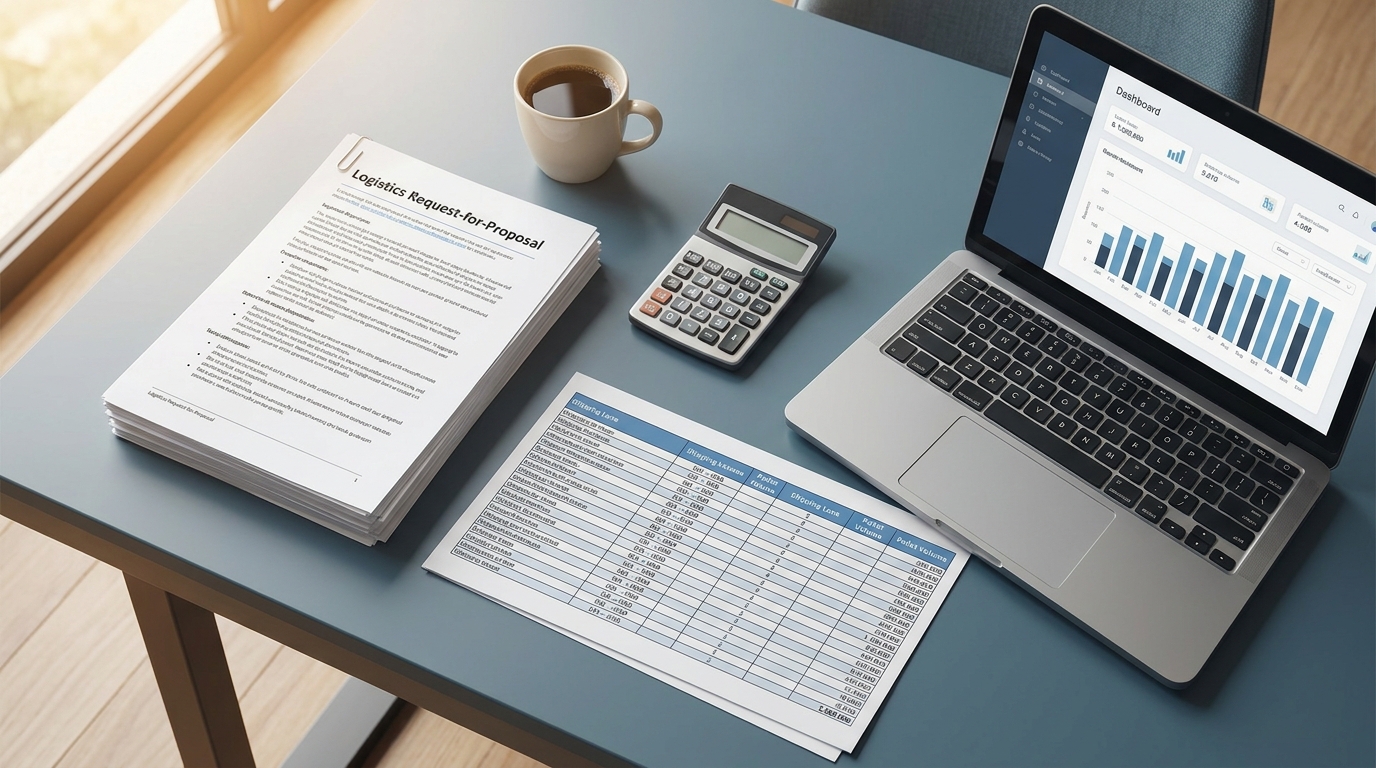
A logistics RFP is a request for proposal that asks freight, warehousing, or 3PL providers to describe how they would run your shipping and then price it against your real volumes. A strong logistics RFP does two jobs at once: it gives every provider the same complete data so their quotes are accurate, and it forces those quotes into a common format so you can compare them apples-to-apples. Get either job wrong and you end up choosing between numbers that were never measuring the same thing.
Key takeaways
- An RFP asks providers to propose an approach and price it; an RFQ just asks for rates on a scope you have already locked down.
- The quality of your quotes is capped by the quality of your data. Accurate lane, volume, and packaging detail is what lets a provider quote without padding.
- Standardize the pricing format up front so responses arrive in the same structure you can normalize and score.
- Define SLAs and KPIs before you send it, because a rate means nothing without the service level attached to it.
- Score on total landed cost plus service and fit, not the lowest headline rate.

What is a logistics RFP and when do you need one?
A logistics RFP is a structured document that invites qualified providers to propose how they would handle a defined body of freight or fulfillment work, then submit pricing on standardized terms. You need one when the spend is large enough, or the service requirements specific enough, that a quick phone quote will not protect you. Recurring truckload or LTL lanes, a warehousing and 3PL move, a cold storage program, or a bid across dozens of lanes all justify a formal RFP.
If your scope is already fixed and you only want competitive rates, a request for quote (RFQ) is lighter and faster. Reach for a full RFP when you are choosing a partner and the how matters as much as the price. For narrower questions, tools like a 3PL RFQ builder can help you assemble the request without starting from a blank page.
What sections should a logistics RFP include?
Every logistics RFP should cover the same core sections so providers know exactly what to respond to. The checklist below is the backbone. Trim what does not apply to your mode, but do not skip the data-heavy sections, because those are what let a provider quote accurately instead of guessing.
| Section | What it contains | Why it matters |
|---|---|---|
| Company and volume overview | Who you are, what you ship, annualized volume, growth outlook | Lets providers size the account and decide if it fits their network |
| Scope of services | Modes, services, and geography you need covered (LTL, FTL, drayage, warehousing, fulfillment) | Defines exactly what they are proposing on |
| Lane and location data | Origin and destination points, lane list, facility addresses, dock and equipment details | The raw input a rate is built from |
| SLAs and KPIs | Transit windows, on-time targets, damage and accuracy thresholds, reporting cadence | Attaches a service level to every rate |
| Pricing format | The required rate template, units, and accessorial disclosure rules | Forces comparable, all-in responses |
| Timeline | Key dates for questions, submission, decision, and go-live | Keeps the process on schedule for everyone |
| Evaluation criteria | How you will score cost, service, technology, and fit | Signals what actually wins the award |
What data do providers need to quote your freight accurately?
Providers can only quote as well as the data you give them, so the lane and volume section carries most of the weight. Vague inputs force a provider to pad the number to protect themselves, or to requote after they see reality. Give them enough to price with confidence the first time.
For freight, that means origin and destination points or a full lane list, annualized volume by lane, freight class or commodity and packaging, pallet or unit dimensions and weights, required service levels and delivery windows, accessorials such as liftgate or inside delivery, and any seasonality or peak. For warehousing and fulfillment, add SKU count, units per order, storage type, and monthly order volume. If you are unsure of a shipment's class or billable weight, a freight class calculator and a dimensional weight calculator will let you hand providers clean numbers instead of estimates they have to hedge against.
How do you define SLAs and KPIs in a logistics RFP?
Define service levels before you send the RFP, because a rate is meaningless without the performance it buys. SLAs (service level agreements) are the commitments a provider makes; KPIs (key performance indicators) are the measurable targets you hold them to.
Spell out transit-time windows per lane, on-time pickup and delivery targets, damage and claims thresholds, order accuracy for fulfillment, and how often you expect performance reporting. State how each KPI is measured and what happens when a target is missed. When every provider prices against the same service bar, a lower rate that quietly assumes a looser standard becomes obvious rather than hidden.

What pricing format should you require?
Require one pricing template that every provider must use, with the same line items and units, and mandate all-in landed pricing that names every accessorial and surcharge. This is the single most important thing you can do to make responses comparable. Left to their own formats, one provider quotes a clean per-mile rate while another buries fuel and handling in fine print, and the two bids look nothing alike.
Name the accessorials you expect to see, such as fuel surcharge, detention, liftgate, and residential or inside delivery, and require them to be disclosed even if quoted at zero. For imports or cross-border freight, ask for duties, brokerage, and drayage to be broken out; a landed cost calculator helps you sanity-check the total a provider returns. Ask for the rate structure too, not just the number, so you understand how costs scale as your volume grows.
How should you set the RFP timeline?
Give providers enough runway to build a real proposal and give yourself enough to evaluate one. A rushed timeline produces padded, defensive bids because a provider that cannot properly cost the work will price for the unknown.
A workable schedule names the issue date, a window for written questions, the answer date when you publish responses to everyone, the submission deadline, your evaluation and shortlist period, and a target go-live. Building a genuinely new warehousing or 3PL program needs more runway than repricing familiar lanes. Publish clarifying answers to all invited providers at once so nobody bids on different assumptions.
How do you evaluate responses apples-to-apples?
Score every response on the same normalized basis, not on headline rates. Because you required a common pricing template, you can apply each provider's rates to your real projected volume and compare total annual landed cost on identical assumptions.
Then weigh service and fit alongside cost. A simple weighted scorecard across total cost, service and SLA credibility, technology and visibility, network coverage, and references keeps the decision honest and defensible. Before you shortlist, verify carrier authority and safety history through the FMCSA, and use published freight-market data from the Bureau of Transportation Statistics to reality-check whether a bid sits far above or below the current market. When you are ready to build a shortlist, you can find logistics companies by mode and region to invite.
What are common mistakes that sink a logistics RFP?
The most common failure is thin data: providers cannot quote accurately, so they pad, and your comparison is built on guesses. Close behind is letting each provider answer in its own format, which makes normalization nearly impossible. Sharing your incumbent rates is another trap, because it anchors every bid near your current cost instead of surfacing a better structure.
Worked example: a brand ships about 40 LTL loads a month across a dozen lanes and sends a two-line email asking for a quote. One provider replies with a per-hundredweight rate, another with a flat per-shipment rate, and a third with a rate plus a separate fuel and accessorial schedule. None of them can be compared without rebuilding the math by hand, and none priced against the brand's real freight class or delivery windows. Rerun the same request as a proper RFP with a lane file, a locked pricing template, and defined SLAs, and the three responses drop into the same spreadsheet. If your freight is FBA-bound, the same discipline applies to prep and inbound quotes; the FBA prep RFP template shows what to send before asking for a number. Choosing a brokered solution instead of asset carriers raises its own questions, covered in how to choose a freight broker.
Frequently asked questions
How long should a logistics RFP be?
Long enough to fully describe your freight and expectations, and no longer. Most single-mode RFPs run a handful of pages of scope plus a structured pricing template and a lane or volume file. The data attachments matter more than the prose. If a section does not change how a provider prices or performs, cut it.
What is the difference between an RFP and an RFQ in logistics?
An RFQ (request for quote) asks providers to price a defined scope you have already locked down, so it is mostly a rate exercise. An RFP (request for proposal) asks providers to propose how they would run the work, including approach, technology, and service commitments, then price it. Use an RFP when you are choosing a partner, and an RFQ when you only need competitive rates for a known scope.
How many providers should I invite to a logistics RFP?
Enough for real competition without drowning your evaluation. A shortlist of roughly three to six qualified providers is common. Inviting too many wastes their time and yours, and it signals that you are fishing for a number rather than choosing a partner, which can lower the quality of the responses you get back.
Should I include my current rates in the RFP?
Generally no. Sharing incumbent rates anchors every bid near your current cost and discourages providers from showing you a materially better structure. Share volumes, lanes, and service requirements so providers can price accurately, but let them build the number from your data rather than matching a target you handed them.
How do I compare quotes that are structured differently?
Force a common format. Give every provider the same pricing template with the same line items and units, and require all-in landed pricing that names every accessorial and surcharge. Then normalize each bid to your real projected volume so you compare total annual cost on identical assumptions, not headline rates.
What data do providers need to quote my freight accurately?
At minimum: origin and destination points or a lane list, annualized volume, freight class or commodity and packaging, pallet or unit dimensions and weights, service levels and delivery windows, accessorial needs like liftgate or inside delivery, and any seasonality. Missing data forces providers to pad their quotes or requote later.
Ready to compare providers?
Search the directory by service and location, save options to your shortlist, and send a clear RFQ.
Related guides
What Is Freight Audit and Payment?
Freight audit and payment checks every carrier invoice against your contracted rate and the bill of lading, corrects overcharges, pays the carrier, and captures the cost data.
Reverse Logistics: Returns, Recalls, and Recycling
A complete guide to reverse logistics: the backward flow of returns, recalls, repairs, redistribution, recycling, and disposal, plus how to recover value and choose a provider.
What Is Breakbulk Shipping?
Breakbulk shipping moves non-containerized ocean cargo as individual pieces, and it is how oversized and heavy loads that will not fit a container travel by sea.