
How to Palletize Freight the Right Way
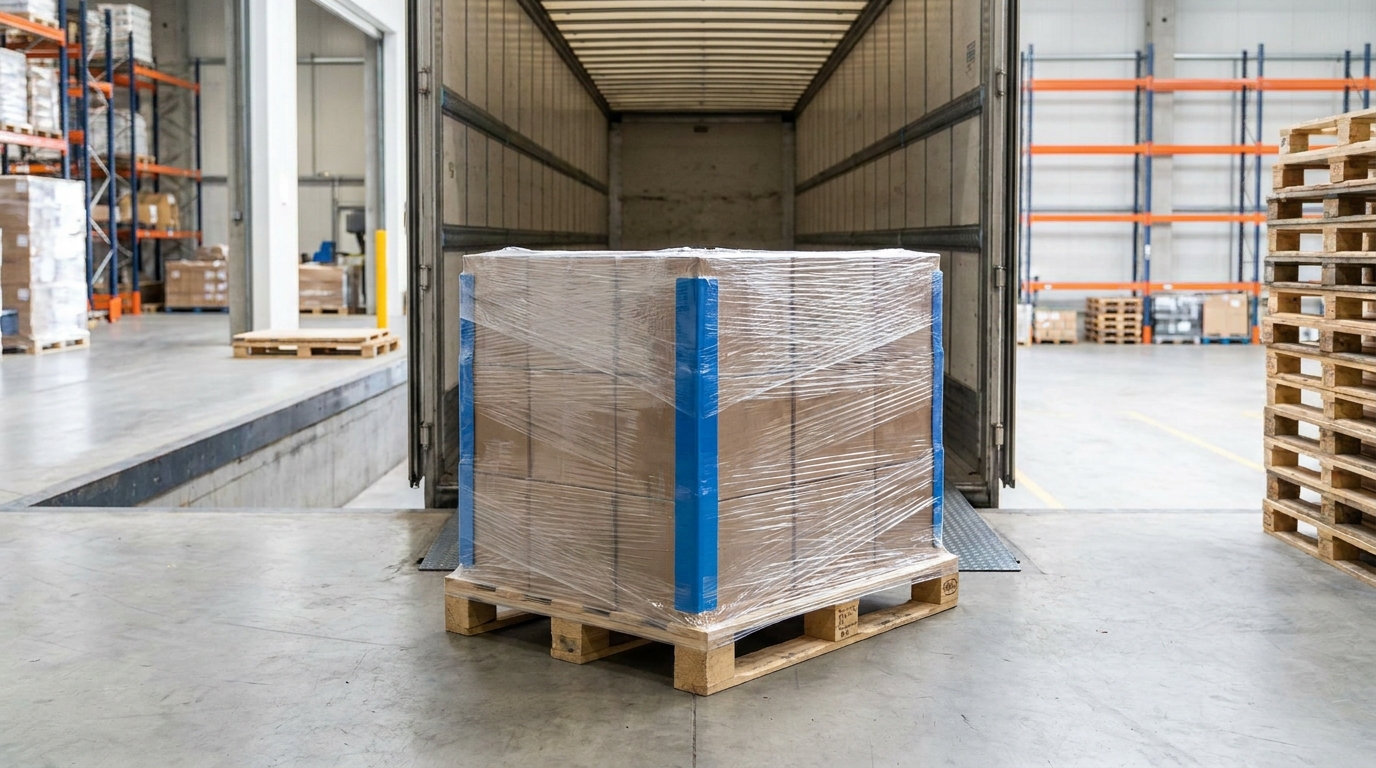
To palletize freight the right way, start with a sound pallet sized to your cartons, keep every box fully on the deck with no overhang, stack the heaviest cartons on the bottom, square the load so it is a tight rectangular cube, then stretch wrap from the pallet base upward and add banding or corner boards on heavy or tall loads. Done well, palletizing does two things at once: it protects your goods from the forklift, the dock, and the road, and it tightens your cube so the shipment measures denser, which is what drives a favorable freight class and a lower rate.
Key takeaways
- Match the pallet to the load: a 48 by 40 inch GMA pallet is the North American standard, and the pallet must be dry, unbroken, and rated for your weight.
- Heaviest cartons go on the bottom, load is squared to the pallet edges, and nothing overhangs the deck.
- Column stacking gives the most vertical strength; interlocked stacking gives more stability for lighter or mixed cartons.
- Stretch wrap must tie the boxes to the pallet, not just band the boxes together, and heavy or tall loads also need strapping and corner boards.
- A tighter cube raises density, which lowers freight class and cuts both damage claims and cost.
What pallet should you use to ship freight?
Use a pallet that is intact, dry, and rated for your weight, and size it so your cartons cover the deck without hanging over. The North American standard is the 48 by 40 inch GMA (grocery) pallet, which fits two-abreast in a standard 53-foot trailer and is what most carriers and warehouses expect. Inspect before you load: no cracked stringers, no protruding nails, no broken deck boards, and no moisture or contamination that could transfer to your goods.
Match the pallet to the job. A four-way block pallet lets a forklift or pallet jack enter from any side and holds up better to repeated handling than a stringer pallet. Wood is the default; plastic costs more but is consistent in weight and dimension, which helps with food or when controlling cube. If your cartons are smaller than a 48 by 40 footprint, a 42 by 42 or custom size gives a squarer, tighter stack than forcing small boxes onto a large deck.
Column stacking vs interlocked stacking: which is stronger?
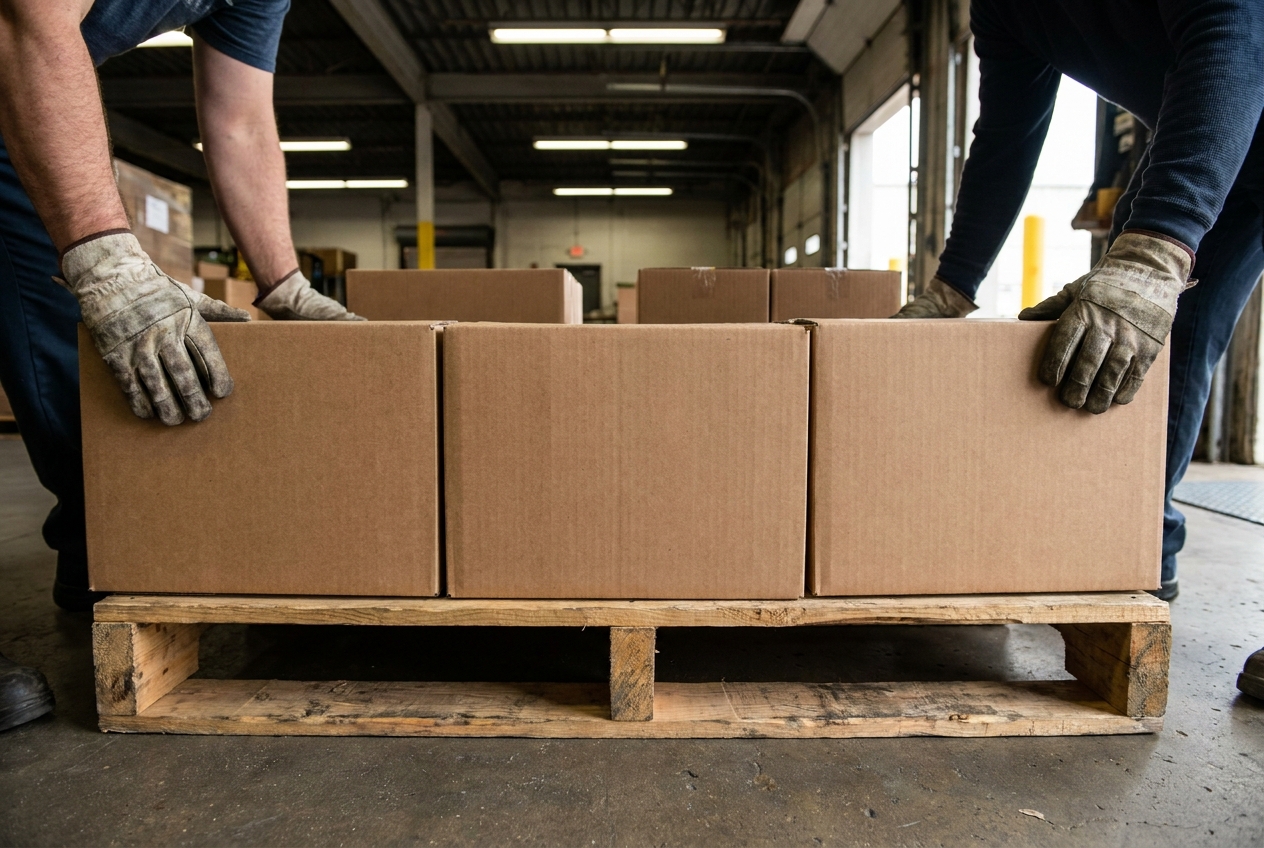
Column stacking aligns every carton directly on top of the one below so the corners line up in vertical columns, and it delivers the most compression strength because a box carries most of its load through its corners. Interlocked stacking rotates alternating layers in a brick pattern so boxes tie across the seams, trading some vertical strength for a stack that holds together better and resists toppling. Neither is universally right; the choice depends on your carton strength and how the load will be handled.
| Factor | Column stacking | Interlocked stacking |
|---|---|---|
| Compression strength | Highest; corners stack over corners | Reduced; corners land on box faces |
| Lateral stability | Lower; layers can shear apart | Higher; layers tie together |
| Best for | Strong, uniform cartons stacked tall | Lighter or mixed-size cartons |
| Reliance on wrapping | Needs firm wrap and often corner boards | More self-stabilizing before wrap |
| Cube efficiency | Very tight when boxes match | Slightly looser at the seams |
A practical compromise for uniform cartons is to column stack for strength, then add corner boards plus firm stretch wrap for the lateral stability columns lack. For mixed or lighter goods, interlock and accept a slightly looser cube for a stack that does not walk apart on a rough lane.
How do you distribute weight on a pallet?
Put the heaviest, densest, and sturdiest cartons on the bottom and lighter or more fragile items on top, so the base carries the compression and nothing crushes underneath. Keep weight even across the four quadrants of the deck rather than loading one side, which prevents the pallet from tipping when a forklift lifts it and keeps it stable when it is stacked or moved by pallet jack.
Build in flat, level layers so each layer is a stable surface for the next. Avoid pyramiding, where the stack narrows as it rises, because the tapered top has nothing to brace against and shifts in transit. If cartons differ in height, group like heights into the same layer and use a slip sheet between layers to spread the load and reduce abrasion.
Why does freight overhang cause damage?
Overhang is when cartons extend past the edge of the pallet, and it is one of the most common and most avoidable causes of freight damage. A carton gets most of its strength from its vertical corners; when those corners hang off the deck with no support beneath them, they lose a large share of their compression strength and crush under the weight above. Overhanging boxes are also the first thing struck by a forklift, a neighboring pallet, or a trailer wall.
Keep the load fully within the pallet footprint. Underhang, where boxes sit well inside the deck, wastes cube and can let the load lean, so the target is boxes squared right to the pallet edge with nothing past it. When your cartons will not fit the deck without overhang, that is a signal to change pallet size rather than accept the overhang.
How do you stretch wrap a pallet correctly?
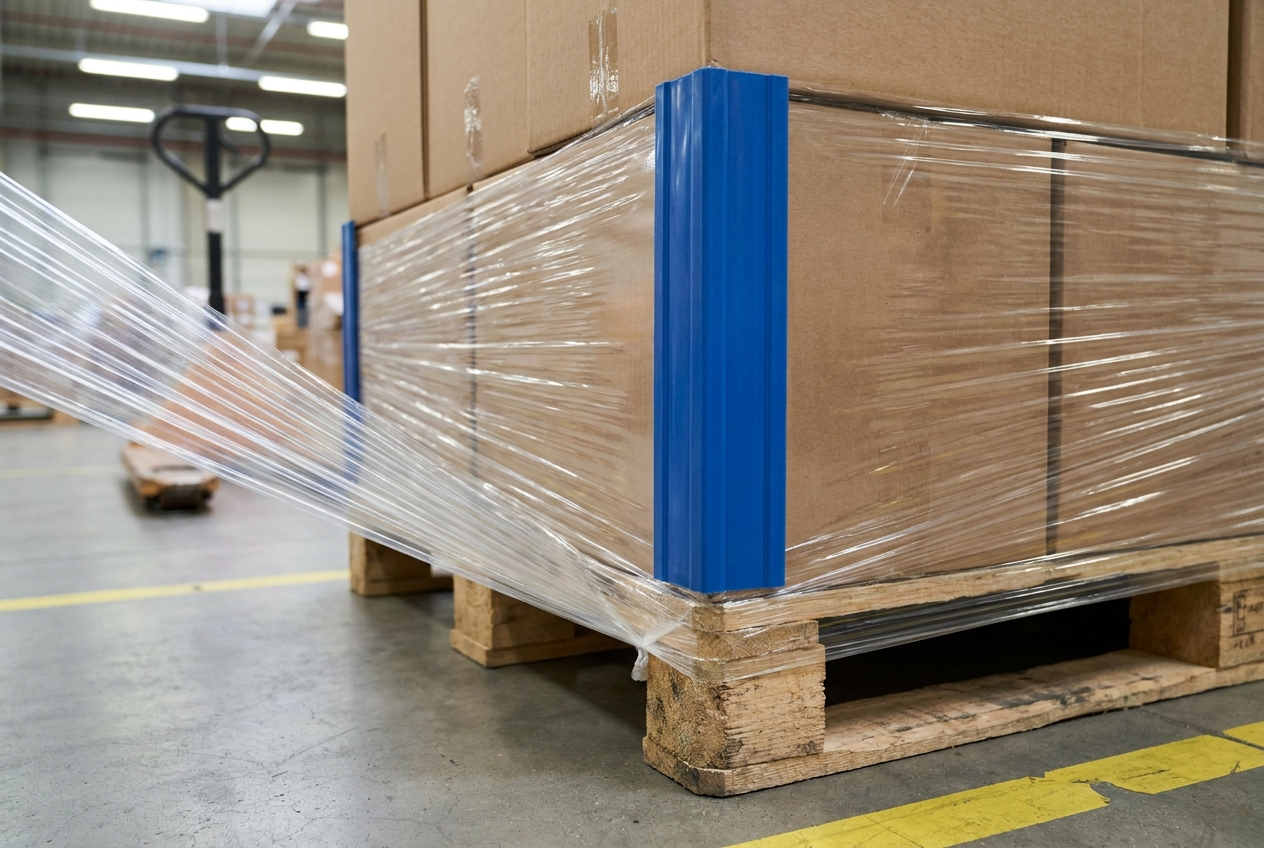
Wrap so the film ties the load to the pallet, not just to itself. Start by twisting a tail of film into a rope and anchoring it to a corner of the pallet base or through a stringer, then make two to three tight wraps around the bottom to lock the boxes to the deck. Spiral upward with roughly half-width overlap on each pass, keeping steady tension, then add two to three wraps at the top and work back down so the load is captured top and bottom.
Use enough film and tension that the load feels like one unit when you push on it, but not so much that the film cuts into carton edges. For tall or heavy loads, run the wrap over corner boards on the vertical edges; the boards spread the tension, add rigidity, and stop the wrap from crushing the outer cartons. Hand film works for low volume; a stretch wrap machine gives more consistent containment force if you ship pallets daily.
When should you band or strap a pallet?
Add banding when stretch film alone cannot restrain the load: heavy or dense freight, tall stacks, drums, machinery, bagged goods, or anything with hard edges. Strapping, whether polyester, polypropylene, or steel, holds the load down onto the pallet under real tension and resists the vertical and lateral forces of a hard stop or a rough rail interchange. Run straps over the top and down through the pallet openings so the load is cinched to the deck, not just belted around the boxes.
Always place edge protectors under the straps where they cross a carton corner, or the tensioned band will cut into the box it is meant to protect. Banding and wrapping are complements, not substitutes: strap for restraint, wrap for containment and to keep dust and small parts in place. For fragile or high-value goods, corner boards under both the straps and the film give the most protection per dollar.
How does tight palletizing affect freight class and cost?
A tighter pallet raises your shipment density, and density is the single biggest input into freight class, the standardized code that carriers use to price less-than-truckload shipments. Density is your total weight divided by the total cubic feet the shipment occupies, including the pallet and any air inside a loose stack. When you square the load, eliminate overhang, and avoid pyramiding, you shrink the cubic feet for the same weight, which raises density and can drop you into a lower, cheaper class.
Run your real dimensions and weight through the freight class calculator before you book, because a stack that measures 60 inches tall instead of 72 can change the class and the rate. Loose palletizing costs twice: it inflates the billable cube and it invites reweigh and reclass fees when the carrier remeasures on the dock. Tight cube and clean, damage-free pallets are also what keep your claim rate low, which is covered in the sibling guide on preventing freight damage. If you ship less-than-truckload regularly, compare specialists on the LTL freight directory and read up on how to reduce LTL freight costs to see how packaging feeds directly into rate.
A worked example: palletizing a 40-carton shipment
Say you have 40 identical cartons, each 16 by 12 by 12 inches and 20 pounds, going out as a single LTL pallet. On a 48 by 40 pallet you can fit eight cartons per layer squared to the deck with no overhang, giving five even layers about 60 inches tall and 800 pounds of product. Column stack the layers for compression strength since the cartons are uniform, add corner boards on all four vertical edges, and stretch wrap from the base up with a top-and-bottom capture.
With the pallet included, that load occupies roughly 40 cubic feet and weighs about 850 pounds, for a density near 21 pounds per cubic foot, which lands in a favorable class range for typical goods. Loosely stacked to 72 inches with a few boxes overhanging, the same cartons would inflate the cube, cut the density, and push the class and rate up, on top of a higher chance of crushed corners on arrival. The same freight costs meaningfully more or less based purely on how it is built. The shipper tools hub and the dimensional weight calculator let you model it before the carrier does. Carrier handling and safe-loading guidance is published by the FMCSA, and national freight movement data is tracked by the Bureau of Transportation Statistics.
Frequently asked questions
What is the correct way to palletize freight?
Choose a sound pallet rated for your load, keep boxes fully on the deck with no overhang, place the heaviest cartons on the bottom, square the stack to the pallet edges, then stretch wrap from the base up and add banding or corner boards for tall or heavy loads.
Should I use column or interlocked stacking?
Use column stacking when cartons are strong and you want maximum vertical strength, since box corners carry the load. Use interlocked stacking for lighter or mixed cartons that need a tied-together, more stable stack that resists toppling in transit.
How does palletizing affect freight class?
Freight class is driven largely by density, which is weight divided by the total cubic feet the shipment occupies. Tighter, squarer pallets take up less space per pound, raise density, and can move the shipment into a lower, cheaper class.
How much can freight overhang a pallet?
Aim for zero overhang. Cartons that hang past the pallet edge lose the support of the deck, crush at the corners, and are the first thing damaged by forklifts and neighboring freight. Overhang of even an inch measurably raises damage rates.
How many times should I wrap a pallet with stretch film?
There is no single number, but a common practice is to anchor the film to the pallet base, make two to three wraps at the bottom, spiral up with roughly half-width overlap, and finish with extra wraps at the top. The film must tie the load to the pallet, not just wrap the boxes.
When should I band or strap a pallet in addition to wrapping?
Band heavy, dense, or tall loads, drums, and anything with hard edges that film alone cannot restrain. Use edge protectors under the straps so the banding does not cut into cartons, and combine banding with stretch wrap rather than relying on either alone.
Ready to compare providers?
Search the directory by service and location, save options to your shortlist, and send a clear RFQ.
Related guides
Carrier Vetting: How to Avoid Fraud and Bad Carriers
A step-by-step guide to carrier vetting: verify FMCSA authority and safety, confirm insurance with the insurer, spot red flags, and stop double-brokering.
Dedicated vs Common Carrier: Which Fits
How dedicated contract carriage, common carriers, and private fleets compare on cost, capacity, and commitment, and when your volume justifies dedicated.
Shipping Construction Materials to a Jobsite
How construction freight works: matching flatbed and specialized trailers to steel, lumber, pipe, and precast, plus jobsite access, oversize permits, and delivery timing.