
Data Center Logistics: Moving IT Infrastructure
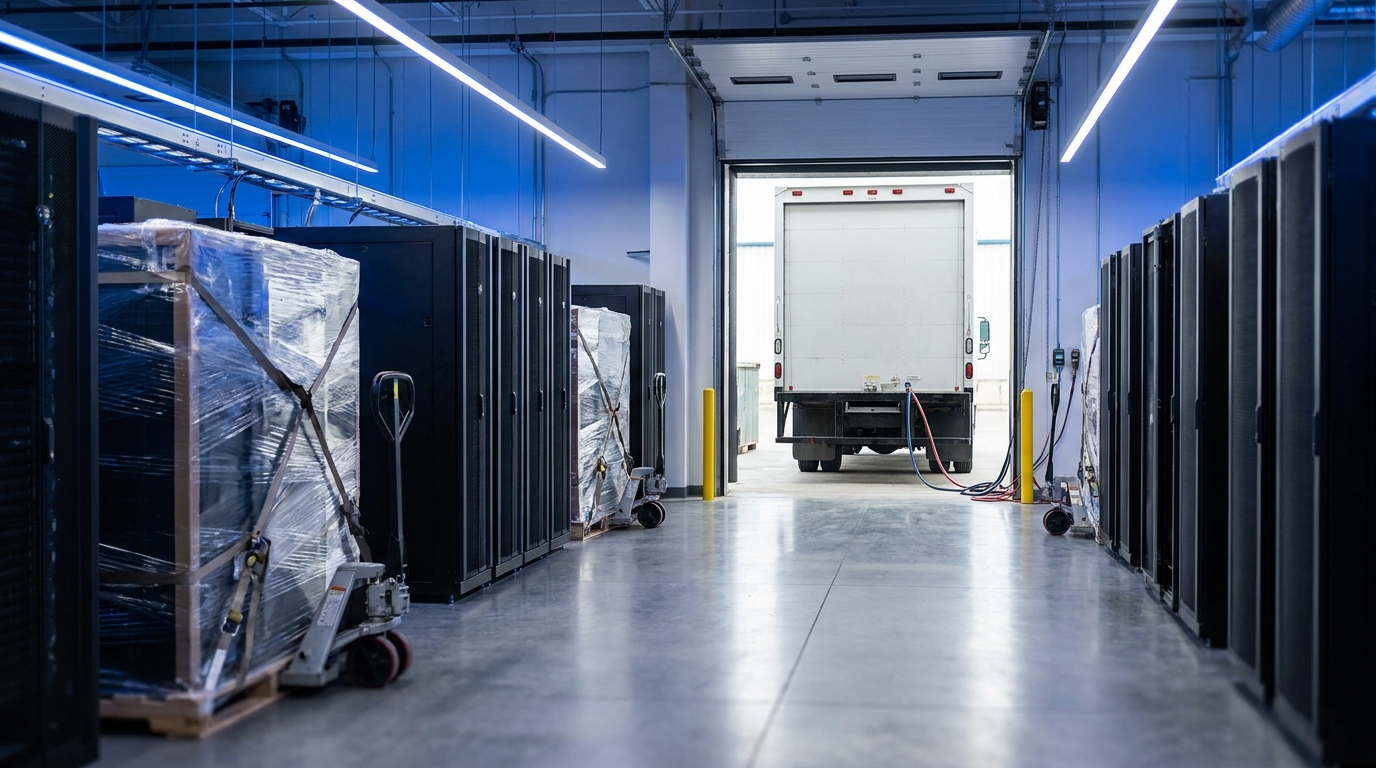
Data center logistics is the specialized handling and transport of IT infrastructure, including servers, storage arrays, network switches, and fully populated racks, from one facility to another. It combines white glove IT transport, staging and configuration warehousing, secure chain-of-custody delivery, sensitive-equipment protection, and on-site install or decommission work. The gear is high-value, shock-sensitive, and often loaded with regulated data, so a standard freight carrier is rarely the right fit.
Key takeaways
- Data center logistics covers the full lifecycle of IT hardware in motion: pickup, staging, transport, install, and decommission.
- White glove IT transport means trained technicians handle equipment inside-to-inside, not just dock-to-dock.
- Staging and integration warehouses rack, cable, image, and burn in gear before it ships, so it arrives pre-configured and tested.
- Chain of custody, tracked by serial number, is what separates a secure IT move from ordinary freight.
- Air-ride and climate-controlled transit protect shock- and temperature-sensitive equipment that pallet freight would damage.
Whether you are consolidating facilities, migrating to colocation, or standing up a new site, the moving parts are the same. This guide covers what data center logistics involves, why it needs specialized providers, and how to compare them.
What does data center logistics involve?
Data center logistics involves every step required to move IT infrastructure safely between locations without losing data, damaging hardware, or breaking the audit trail. At minimum that means secure pickup, protective packaging, monitored transport, and controlled placement at the destination. Most projects also add pre-shipment staging and post-delivery install or teardown.
Think of it as a chain with five links: white glove transport, staging and integration, chain-of-custody security, sensitive-equipment handling, and rack-and-stack or decommission. A weak link anywhere, a mishandled rack, an unlogged asset, a trailer that runs hot, can turn a clean migration into downtime and a compliance headache.
Why does moving IT infrastructure need specialized providers?
Moving IT infrastructure needs specialized providers because live data center gear behaves nothing like palletized freight. Servers and switches are sensitive to shock, vibration, static, temperature, and humidity, they carry serial-tracked value that runs from thousands to millions of dollars, and they frequently hold data governed by security or privacy rules.
A general LTL carrier optimizes for dock-to-dock movement of boxed or palletized goods. It typically does not offer inside pickup and delivery, anti-static handling, air-ride equipment, serialized chain of custody, or technicians who can safely de-rack and re-rack hardware. When you are vetting any carrier that will touch this equipment, confirm active operating authority and safety record through the FMCSA, then confirm the IT-specific capabilities on top of that. Specialized data center movers exist because that combination is not a standard freight product. You can compare providers by capability in the data center logistics category of our directory.
What does white glove IT transport include?
White glove IT transport is a service in which trained technicians handle the equipment end to end, including inside-the-building pickup and delivery, rather than leaving it on a loading dock. It is the baseline for anything you cannot afford to have dropped, jostled, or left unattended.
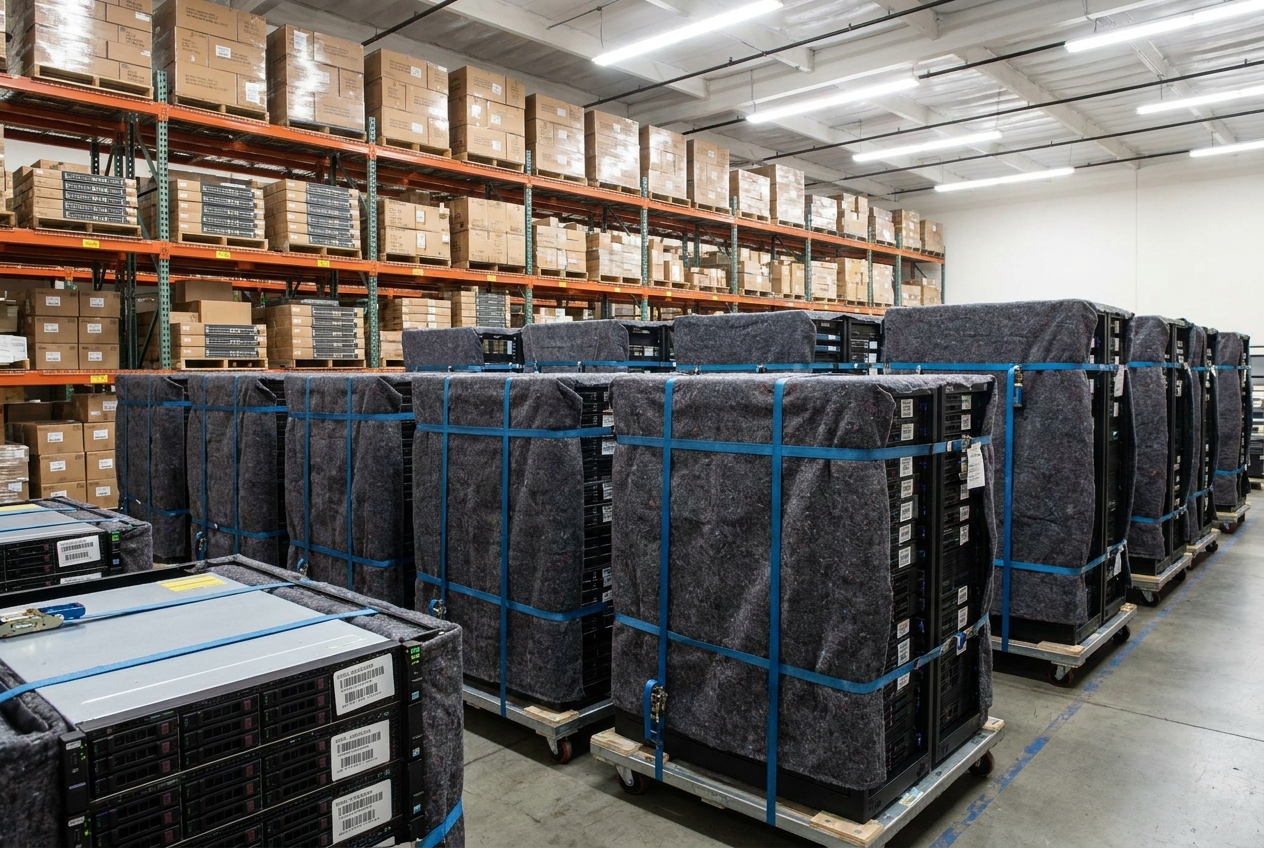
A typical white glove IT scope includes protective blanket-wrap or custom crating, careful de-rack at origin, air-ride transit, placement in the exact rack and slot at destination, cabling to a provided layout, debris removal, and takeaway of all packaging. The same discipline applies to other fragile, high-value freight, which is why the practices overlap heavily with general white glove delivery and with regulated moves like medical device logistics. If a provider quotes standard freight rates with no mention of inside delivery or technician handling, it is not white glove, whatever the sales sheet says.
How do staging and integration warehouses work?
A staging or integration warehouse receives, inventories, racks, cables, images, and tests IT equipment before it ships to the live site, so hardware arrives pre-configured. Instead of unboxing hundreds of servers in a production facility, you do that work in a controlled space and ship known-good, rack-ready assets.
A good integration warehouse will asset-tag and serial-scan every unit on receipt, build and cable racks to your elevation drawings, load firmware and images, and burn in the equipment to surface dead-on-arrival failures early. It then wraps and secures the populated racks for transport. This is where a lot of project risk gets removed: catching a failed drive or a mis-imaged switch on a warehouse bench costs hours, while catching it during a live cutover can cost a maintenance window.
How is secure, chain-of-custody transport handled?
Secure chain-of-custody transport is a documented, unbroken record of who handled each asset and when, tracked by serial number or asset tag from pickup through final placement. For equipment holding sensitive data, this is often the single most important part of the engagement.
In practice, providers scan each asset at every handoff, use sealed and sometimes GPS-tracked vehicles, run background-checked crews, and produce a reconciled manifest at delivery that matches what left the origin. On decommission, the same trail extends to certified data wipe or physical destruction with serialized certificates. If your equipment falls under security or privacy obligations, ask exactly how the provider documents custody and what proof you receive at the end. Point them to the same tags you use in your provider search so the manifest matches your records.
How is sensitive equipment protected in transit?
Sensitive IT equipment is protected in transit with air-ride trailers that cushion shock and vibration, climate control that holds temperature and humidity in range, anti-static packaging, and custom foam or crating sized to the hardware. Spinning disks, optics, and densely populated racks are the least forgiving of a rough ride.
Many providers add shock and tilt indicators or in-transit data loggers so you can verify the load was never dropped, tipped, or exposed to out-of-range conditions. Consider a fully populated 42U rack weighing roughly 1,500 to 2,000 pounds: on a standard trailer, road vibration alone can unseat cards or loosen drives, while an air-ride rig with a monitored environment holds it stable and lets you prove it on arrival. Ask whether climate control runs continuously, including during dwell time at a terminal, not only while the truck is moving.

What are rack-and-stack and decommission services?
Rack-and-stack is the on-site work of mounting equipment into racks, cabling power and network, labeling, and dressing cables to a documented layout so the room matches the design. Decommission is the mirror image: powering down, de-cabling, inventorying, and removing retired gear for redeployment, resale, or certified destruction.
Handled together, these services close the loop on a migration. A provider stands up the new site rack-ready, then decommissions the old one with a serialized asset list and disposition records for every unit. That matters for finance, for security, and for sustainability reporting, since responsible disposal and energy-efficient siting increasingly show up in facility planning; the U.S. Energy Star program tracks data center efficiency as one input. Confirm who owns cabling standards, labeling, and post-install cleanup before work starts, since gaps there are a common source of finger-pointing.
How do you compare data center logistics providers?
Compare data center logistics providers on the specific capabilities your project needs, not on a generic freight quote. The table below maps the core requirements to what a shipper should verify before signing.
| Requirement | What it covers | What to verify |
|---|---|---|
| White glove IT transport | Inside pickup and delivery, technician handling, exact-slot placement | Trained crews, not general dock labor; packaging takeaway included |
| Staging and integration | Receive, rack, cable, image, burn-in before shipment | Serial-scan on receipt, burn-in process, elevation-drawing builds |
| Chain-of-custody security | Serialized tracking, sealed vehicles, vetted crews, reconciled manifest | Background checks, per-handoff scans, delivery reconciliation report |
| Sensitive-equipment handling | Air-ride, climate control, anti-static, custom crating | Continuous climate control, shock and tilt indicators or data loggers |
| Rack-and-stack and decommission | On-site install, cabling, teardown, certified disposal | Cabling and labeling standards, wipe or destruction certificates |
| Carrier legitimacy | Operating authority and safety record of the transport leg | Active FMCSA authority, insurance limits that match asset value |
Score each candidate against the requirements that actually apply to your move. A single-rack colocation migration does not need a full integration warehouse, while a two-site consolidation with regulated data needs every row in the table. Match the scope to the risk, get the chain-of-custody and insurance terms in writing, and you will spend far less time worrying about the equipment in the truck.
Frequently asked questions
What is data center logistics?
Data center logistics is the specialized handling and transport of IT infrastructure such as servers, storage arrays, network switches, and full racks. It covers white glove IT transport, staging and configuration warehousing, secure chain-of-custody delivery, sensitive-equipment protection, and on-site rack-and-stack, install, and decommission work.
Why can't a standard freight carrier move servers?
A standard LTL or parcel carrier is built for palletized freight, not live IT gear. Servers are shock-sensitive, static-sensitive, high-value, and often carry regulated data, so they need air-ride equipment, climate control, verified handlers, and a documented chain of custody that most general carriers do not provide.
What is white glove IT transport?
White glove IT transport is a service where trained technicians handle the equipment end to end, including inside pickup and delivery, protective crating or blanket-wrap, air-ride transit, placement in the exact rack location, debris removal, and packaging takeaway. It goes well beyond dock-to-dock freight.
What does a staging or integration warehouse do?
A staging or integration warehouse receives, inventories, racks, cables, images, and burns in equipment before it ships, so gear arrives at the site pre-configured and tested. This shortens on-site install time and lets you catch dead-on-arrival hardware in a controlled environment instead of in a live facility.
What is chain of custody in data center moves?
Chain of custody is a documented, unbroken record of who handled each asset and when, tracked by serial number or asset tag from pickup to final placement. It matters for security, compliance, and audit, especially when equipment holds sensitive data or must be certified as wiped or destroyed on decommission.
What is rack-and-stack service?
Rack-and-stack is the on-site work of mounting equipment into racks, cabling power and network, labeling, and dressing cables to a documented layout. Providers often pair it with decommission services that power down, de-cable, inventory, and remove retired gear for redeployment, resale, or certified destruction.
How is sensitive IT equipment protected during transit?
Sensitive gear moves on air-ride trailers to reduce shock and vibration, often with climate control to hold temperature and humidity, anti-static packaging, and custom foam or crating. Providers may add shock and tilt indicators or data loggers so you can verify the equipment was never dropped or exposed to bad conditions.
Ready to compare providers?
Search the directory by service and location, save options to your shortlist, and send a clear RFQ.
Related guides
What Is Freight Audit and Payment?
Freight audit and payment checks every carrier invoice against your contracted rate and the bill of lading, corrects overcharges, pays the carrier, and captures the cost data.
How to Write a Logistics RFP
A section-by-section guide to writing a logistics RFP that gets accurate, comparable quotes from 3PLs, freight brokers, and carriers.
Reverse Logistics: Returns, Recalls, and Recycling
A complete guide to reverse logistics: the backward flow of returns, recalls, repairs, redistribution, recycling, and disposal, plus how to recover value and choose a provider.