
How to Read a 3PL Invoice (and Catch Overcharges)

A 3PL invoice is the monthly bill from a third-party logistics provider that lists every charge for storing, handling, and shipping your inventory. To read it, split it into its core buckets, storage, receiving, pick-and-pack, outbound shipping, value-added services, and surcharges, then reconcile each line against your signed rate card and your own order data. Overcharges rarely announce themselves. They hide inside vague line labels, duplicated receiving fees, and per-unit rates applied where a bundled rate should be. This guide walks the invoice top to bottom, shows where the money leaks, and works a real example of catching one.
Key takeaways
- A 3PL invoice breaks into six recurring buckets: storage, receiving, pick-and-pack, shipping, value-added services, and surcharges, plus any account minimum.
- The single most useful habit is reconciling the invoice against two things at once: your contract rate card and your own order and inbound records.
- The most common overcharges are double-billed receiving, per-item pick fees applied to items already inside the base pick, and surcharges that duplicate a charge already in another line.
- Dispute errors in writing within your contract's billing window (often 30 to 60 days), citing the line, the clause, and the supporting order data.
- Reconcile fully for the first few months and after any rate change, then spot-check your highest-dollar lines monthly.
What is on a 3PL invoice?
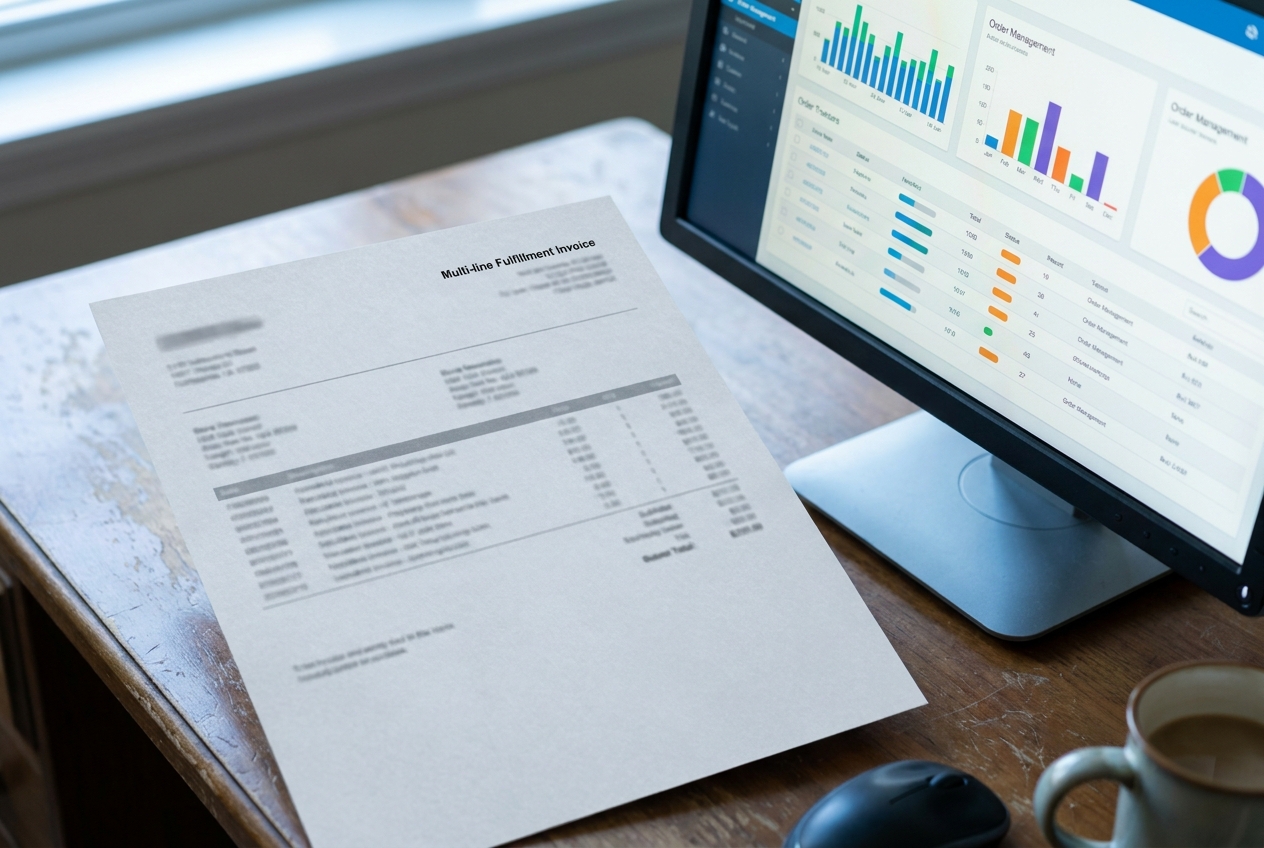
A 3PL invoice records what it cost to keep your inventory in the warehouse and move it out the door over a billing period. It looks like a wall of line items, but almost every charge maps to one of six buckets: storage (the space your goods occupy), receiving or inbound handling (unloading and putting away each shipment you send in), pick-and-pack (pulling and packing each order), outbound shipping (carrier cost, often with the 3PL's markup), value-added services (extras like kitting, labeling, and returns), and surcharges (peak storage, oversized handling, carrier fuel and residential fees, and account minimums).
How is a 3PL invoice structured, line by line?
Most providers order the invoice roughly the way inventory flows through the building: in, stored, out. Reading it in that order makes each charge easier to sanity-check.
- Storage: a recurring charge for the footprint your inventory holds. Watch for how it is measured. Per-pallet billing rewards dense stacking; per-cubic-foot billing punishes bulky, light goods. Confirm the count matches your inventory-on-hand report.
- Receiving: billed per pallet, per carton, per unit, or per labor hour on inbound. One inbound shipment should generate one receiving charge.
- Pick-and-pack: usually a base fee per order that includes the first item or two, plus a smaller per-additional-item rate. This is where bundled-versus-per-unit confusion creates overcharges. Our guide to pick-and-pack fees breaks the structure down further.
- Shipping: the outbound carrier charge. Some 3PLs pass carrier cost through at their negotiated rate, others add a markup or handling fee per label.
- Value-added services: kitting, bundling, FNSKU labeling, gift notes, and returns processing, each with its own unit rate.
- Surcharges and minimums: fuel, peak-season storage, oversized or long-item fees, and any monthly minimum that tops your bill up to a floor.
Where do hidden and double-billed fees hide?
Overcharges cluster in the lines that are hardest to verify by eye. Receiving is a frequent one: a single inbound container split across two dock appointments can appear as two receiving charges. Pick-and-pack is another: if your contract bundles the first two items into the base pick fee but the invoice bills the per-additional-item rate on every item, you pay twice for units already covered. An oversized-handling fee can already be baked into a higher pick rate for a SKU, then appear again as a standalone line. Many of these are the same accessorial charges that inflate freight bills, applied to warehousing. Vague labels like "special handling" or "misc. fulfillment" with no unit count behind them deserve a question every time.
How do you reconcile a 3PL invoice against your contract?
Reconciling means proving each charge is both authorized (in your contract) and accurate (matches what actually happened). Work three documents side by side: the invoice, your signed rate card, and your own order-management and inbound records. For each line, confirm the rate matches the rate card, then confirm the quantity matches your data. If the invoice says 4,000 orders shipped, your order system should agree. If receiving shows six inbound shipments, your purchase-order log should show six. Understanding how your provider prices in the first place makes this faster, so it helps to know your 3PL pricing model before the first invoice lands. When you want to model expected cost ahead of the bill, the warehouse cost calculator gives you a baseline to reconcile against.
Worked example: catching a pick-pack overcharge
Say your rate card sets pick-and-pack at a base fee per order that includes the first two items, plus a per-additional-item fee for anything beyond that. In one month you ship 4,000 orders averaging about 3.1 items each. Your expected pick-and-pack cost is the 4,000 base fees plus the per-item fee on roughly 1.1 extra items per order, a little over 4,000 additional items. The invoice, though, comes in noticeably higher, by around 8,000 items' worth of the per-additional-item rate.
Pulling the order export next to the invoice explains the gap: the 3PL applied the per-additional-item rate to every item, including the two already bundled into the base fee. At 4,000 orders, that is 8,000 items billed twice. The fix is a corrected invoice or a credit, plus a note to re-check that line next month, because a billing-rule error like this usually repeats until it is flagged.

Which 3PL invoice line items should you verify every month?
You do not need to audit every line with equal intensity. Concentrate on the highest-dollar buckets and the ones most prone to error. The table below is a monthly checklist of what each line should be and what to verify against.
| Line item | How it is billed | What to verify |
|---|---|---|
| Storage | Per pallet, bin, shelf, or cubic foot | Unit count matches your inventory-on-hand report; peak-storage surcharge is in season and rate-carded |
| Receiving | Per pallet, carton, unit, or labor hour | One inbound shipment equals one charge; quantity matches your purchase-order log |
| Pick-and-pack | Base fee per order plus per-additional-item | Base includes the bundled items; per-item rate applies only to units beyond the bundle |
| Shipping | Carrier cost, sometimes with markup | Label count matches orders shipped; markup or handling fee matches the contract |
| Value-added services | Per kit, label, or returned unit | Quantity matches the VAS work orders you actually requested |
| Surcharges and minimums | Flat or per-unit | No duplication of a charge already inside another line; minimum only applies if volume fell below the floor |
When does a discrepancy warrant a deeper freight audit?
Spot-checking catches the obvious. A pattern of errors, or a shipping line that keeps drifting from your carrier data, calls for a structured review. That is the point of a freight audit: a systematic check of shipping and accessorial charges against contracted rates and actual shipment data, usually across many invoices at once. Red flags include the same error recurring after you flagged it, surcharges that appear without a clear trigger, and a shipping markup that grows faster than your volume. The freight your 3PL passes through comes from motor carriers whose operating authority you can confirm through the FMCSA, which is worth checking when a new carrier or fee shows up mid-contract.
How do you dispute a 3PL overcharge?
Dispute in writing, and dispute specifically. A vague "this looks high" is easy to deflect. Cite the invoice line, the contract clause that governs it, and the order or receiving data that supports your position, then ask for a corrected invoice or a credit rather than a verbal promise. Check your contract for the dispute window first, since many providers require billing disputes within 30 to 60 days of the invoice date. Treating vendor billing as a recurring cost to manage, the way the SBA frames operating-cost control, keeps small monthly leaks from compounding. If a provider resists routine reconciliation entirely, that itself is a signal worth weighing when you compare warehousing and 3PL providers for your next contract.
Reading a 3PL invoice well is a monthly discipline, not a one-time skill. Bucket the charges, reconcile rate and quantity against your contract and your own data, and dispute the gaps promptly and in writing. Do that consistently and the invoice stops being a wall of numbers you hope are right, and becomes a bill you can defend line by line.
Frequently asked questions
What are the main line items on a 3PL invoice?
Most 3PL invoices group charges into storage (per pallet, bin, or cubic foot), receiving or inbound handling, pick-and-pack fulfillment, outbound shipping, value-added services such as kitting and labeling, and surcharges. Many also apply a monthly account or minimum-volume fee.
Why is my 3PL invoice higher than the quote I signed?
The quote usually covers only base storage and fulfillment. The invoice adds the accessorials your orders actually triggered: peak-season storage, oversized-item handling, carrier surcharges, returns processing, and account minimums. Reconciling the invoice against your rate card shows which of those are legitimate and which are billing errors.
How do I catch a double-billed fee on a 3PL invoice?
Compare the invoice against both your contract rate card and your own order and inbound records. Double billing usually appears as receiving charged twice for one inbound shipment, a per-item pick fee applied to items already bundled into the base pick, or a surcharge that duplicates a charge already inside another line.
What is a reasonable timeframe to dispute a 3PL billing error?
Check your contract for a billing-dispute window, which is often 30 to 60 days from the invoice date. Raise discrepancies in writing with the invoice line, your contract clause, and the order or receipt data that supports your position, and ask for a corrected invoice or credit rather than a verbal adjustment.
Should I audit every 3PL invoice or just spot-check?
Reconcile the full invoice for the first few months and after any rate change, then move to a monthly spot-check of your highest-dollar lines (storage, pick-pack, and shipping) plus a full review each quarter. Errors tend to repeat, so one that appears once often recurs until you flag it.
Are surcharges on a 3PL invoice usually negotiable?
Pass-through carrier surcharges are hard to negotiate because the 3PL is re-billing what a carrier charged it. Handling surcharges the 3PL sets itself, such as oversized, long-item, or peak-storage fees, are often negotiable at contract renewal, especially if your volume has grown.
Ready to compare providers?
Search the directory by service and location, save options to your shortlist, and send a clear RFQ.
Related guides
What Is Freight Audit and Payment?
Freight audit and payment checks every carrier invoice against your contracted rate and the bill of lading, corrects overcharges, pays the carrier, and captures the cost data.
How to Write a Logistics RFP
A section-by-section guide to writing a logistics RFP that gets accurate, comparable quotes from 3PLs, freight brokers, and carriers.
Reverse Logistics: Returns, Recalls, and Recycling
A complete guide to reverse logistics: the backward flow of returns, recalls, repairs, redistribution, recycling, and disposal, plus how to recover value and choose a provider.